About Gavialis gangeticus (Gmelin, 1789)
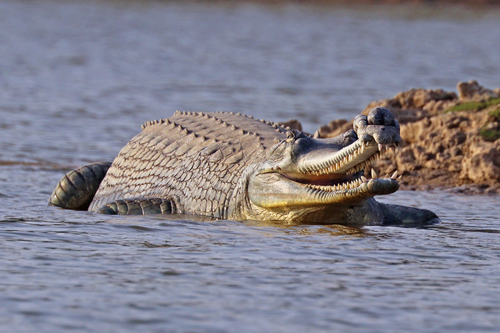
Characteristics of the gharial (Gavialis gangeticus): Gharials are olive-colored, with adult individuals darker than young individuals. Young gharials have dark brown cross bands and speckles. A gharial's back turns almost black by the time it reaches 20 years of age, while its belly is yellowish-white. It has four transverse rows of two scales on the neck, which continue along its back.
Scales and Snout
Scutes on the head, neck and back form a single continuous plate made up of 21 to 22 transverse series and four longitudinal series. Back scutes are bony, while side scutes are softer and have feeble keels. The outer edges of the forearms, legs, and feet have protruding crests, and the fingers and toes are partially webbed. The gharial has a very long and narrow snout that widens at the end, with 27 to 29 upper teeth and 25 or 26 lower teeth on each side of the jaw. The front teeth are the largest, and the first, second, and third lower jaw teeth fit into gaps in the upper jaw. Its extremely long mandibular symphysis extends to the 23rd or 24th tooth. The snout of an adult gharial is 3.5 times longer than the width of the skull base. This long snout is a specific adaptation for catching and eating fish. The nasal bones are relatively short and are widely spaced from the premaxillae, and the jugal bone is raised. The snout becomes proportionally thicker as the gharial ages. Two gharials weighing between 103–121 kg (227–267 lb) had an average measured bite force of 1,784–2,006 N (401–451 lbf).
Sexual Dimorphism
When male gharials reach sexual maturity, they develop a hollow bulbous nasal protuberance at the tip of the snout. This protuberance resembles a local earthen pot called a "ghara", which gives the species its name. The male ghara begins growing over the nostrils at 11.5 years of age, and measures approximately 5 cm × 6 cm × 3.5 cm (2.0 in × 2.4 in × 1.4 in) when the male is 15.5 years old. It allows males to produce a hissing sound that can be heard 75 m (246 ft) away, which is thought to attract females. The gharial is the only living crocodilian that has this kind of visible sexual dimorphism. Mature male gharials have larger skulls than females, with a basal length over 715 mm (28.1 in) and width over 287 mm (11.3 in). Female gharials reach sexual maturity at a body length of 2.6 m (8 ft 6 in) and grow up to 4.5 m (15 ft). Males reach sexual maturity at a body length of at least 3 m (9.8 ft) and grow up to 6 m (20 ft) in length. Adult males average about 160 kg (350 lb) in weight, while large males can reach 600–750 kg (1,320–1,650 lb). The gharial is among the largest living crocodilians; the heaviest recorded male gharial weighed 977 kg (2,154 lb). There are unconfirmed claims of a 6.55 m (21.5 ft) long gharial killed in the Ghaghara River in Faizabad in August 1920, as no reliable measurements were taken. Around the turn of the 20th century, male gharials with claimed lengths of 7.16 to 9.14 m (23.5 to 30.0 ft) were sighted in Indian rivers. Overall, gharials are less massive than other crocodilians of similar length: a 4.9 m (16 ft) long gharial weighed around 560 kg (1,230 lb), while a 4.8 m (16 ft) long Nile crocodile weighed 680 kg (1,500 lb).
Distribution and habitat
Historical Range
The gharial once thrived in all major river systems of the northern Indian subcontinent, spanning from the Indus River in Pakistan, the Ganges in India, the Brahmaputra River in northeastern India and Bangladesh, to the Irrawaddy River in Myanmar. In the early 20th century, it was considered common in the Indus River and its Punjabi tributaries, but was almost extinct in the Indus by the early 1980s, and no gharials were sighted in the river during 2008 and 2009 surveys. It was also native to India's Godavari River, but was hunted to extinction between the late 1940s and 1960s, and has been considered extinct in the Koshi River since 1970. In the 1940s, gharials were numerous in Assam's Barak River, which at the time supported large fish including golden mahseer (Tor putitora). A small number of individuals were sighted in Barak River tributaries spanning Assam, Mizoram and Manipur up to 1988, but no formal follow-up surveys have been conducted. In 1927, a gharial was shot in Myanmar's Shweli River, a tributary of the Ayeyawady River; this is the only authenticated record of gharials surviving into the 20th century in Myanmar. As of 2012, it remained unclear whether gharials still inhabit the Shweli River.
Decline and Recovery
By 1976, the gharial's global range had shrunk to just 2% of its historical range, and fewer than 200 individuals were estimated to survive. It is locally extinct in Pakistan, Bhutan and Myanmar. Since the early 1980s, wild populations in India and Nepal have been reinforced by releasing captive-bred gharials into natural habitats. As of 2019, the global gharial population is estimated at a maximum of 900 individuals. This includes approximately 600 mature adults across six major subpopulations along 1,100 km (680 mi) of river courses, plus another 50 mature adults across eight minor subpopulations along 1,200 km (750 mi) of river courses. In Nepal, small populations survive and are slowly recovering in Ganges tributaries: the Karnali–Babai River system in Bardia National Park, and the Narayani–Rapti river system in Chitwan National Park. In spring 2017, a drone survey of the Babai River detected 33 gharials along a 102 km (63 mi) stretch.
Indian Sites
In India, gharial populations are found in the following locations: Ramganga River in Corbett National Park, where five gharials were recorded in 1974. Captive-bred gharials have been released here since the late 1970s. The population has been breeding naturally since 2008, and grew to around 42 adults by 2013. Most individuals congregate along an 8 km (5.0 mi) stretch of the Kalagarh Reservoir shoreline. 2015 surveys recorded a total population of 90 gharials, including 59 breeding adults. The Ganges, where 494 gharials were released between 2009 and 2012 in Hastinapur Wildlife Sanctuary. The Girwa River in Katarniaghat Wildlife Sanctuary, where the small existing breeding population has been reinforced with captive-reared gharials since 1979. A total of 909 gharials were released here by 2006, but only 16 nesting females were recorded the same year. In December 2008, 105 individuals were counted, including 35 adults. In spring 2009, 27 nests were detected across seven sites. The number of nest sites decreased from seven in 2017 to two in 2019, possibly caused by overgrowth of woody vegetation and reduced river flow near sandbanks. The Gandaki River downstream of the Triveni barrage, west of Valmiki Tiger Reserve and adjacent to Sohagi Barwa Sanctuary. The population grew from 15 gharials in 2010 to 54 individuals recorded in March 2015 along a 320 km (200 mi) stretch, with 35 of these individuals born in the wild. Between the post-monsoon season of 2019 and pre-monsoon 2021, the population in the 320 km (200 mi) river section from the Triveni barrage to the Ganges confluence was estimated at 196 adults, 161 juveniles, 140 sub-adults and 37 yearlings. The Chambal River in National Chambal Sanctuary, where 107 gharials were recorded in 1974. Captive-bred gharials have been released here since 1979, and the population grew to 1,095 gharials by 1992. Between December 2007 and March 2008, 111 gharials were found dead. A 2013 survey along the 414 km (257 mi) protected river stretch counted a total of 948 gharials. In 2017, two different survey teams estimated the population at 617–761 mature individuals and over 1250 total individuals, and 411 nests were found. The Parbati River, a tributary of the Chambal River, where gharials began using a small number of sand banks around 2015. 29 gharials were observed here in 2016, and 251 hatchlings were counted at two nesting sites in 2017. The Yamuna River, where eight young gharials were detected in autumn 2012 near the confluence of the Ken and Yamuna Rivers. They are thought to be offspring of the Chambal River breeding population that drifted downstream during monsoon floods. The Son River, where 164 captive-reared gharials were released between 1981 and 2011. The Koshi River in Bihar, where two gharials were sighted basking in late January 2019 during a survey targeting South Asian River Dolphins (Platanista gangetica) along a ~175 km (109 mi) stretch. This is the first record of wild gharials in the river since the 1970s. The Mahanadi River in Odisha's Satkosia Gorge Sanctuary, where around 700 gharials were released between 1977 and the early 1990s. During a 1.5-year survey in 2005–2006, only one male and one female gharial moving together and sharing sand banks were detected in the river. Between 1979 and 1993, fewer than 20 gharials were sighted in the upper reaches of the Brahmaputra River between Kaziranga National Park and Dibru-Saikhowa National Park. This population declined due to commercial fishing, poaching, human encroachment on gharial breeding grounds, and river bed siltation caused by deforestation, and was considered non-viable in 1998. Between 2004 and 2007, around 30 gharials were observed in small lakes and tributaries of the Brahmaputra River in Assam.
Bangladesh Records
In Bangladesh, gharials were recorded in the Padma, Jamuna, Manhunda and Brahmaputra rivers between 2000 and 2015.
Behaviour and ecology
Aquatic Life
The gharial is the most fully aquatic crocodilian. It only leaves the water to bask on riverbanks. As a cold-blooded animal, it cools down during hot periods and warms up when the ambient temperature is cool. Gharials bask daily in the cold season, most often in the mornings, and prefer sandy, moist beaches. They adjust their basking routine as daily temperatures rise: they begin basking earlier in the morning, return to the river when it becomes hot, and go back to the beach later in the afternoon.
Group Basking
Groups made up of one adult male, several females and subadults have been observed basking together. Adult males dominate these groups and tolerate immature males. Large groups of young, subadult and adult gharials gather to bask in December and January. Adult males and females begin pairing by mid-February.
Shared Habitat
In parts of its range, the gharial shares river habitat with the mugger crocodile (Crocodylus palustris). They use the same nesting grounds, but differ in their selection of basking sites. The gharial basks close to water on shallow, sandy beaches, and only lays eggs in sandy soil near water. The mugger crocodile also basks on sandy beaches, but unlike the gharial it climbs steep embankments and rocks, and moves farther from beaches for both basking and nest building. Mugger crocodiles also prey on fish, but have a broader prey base than gharials that includes snakes, turtles, birds, mammals and carrion.
Feeding ecology
Underwater Hunting
The gharial is well adapted to hunting fish underwater, due to its sharp interlocking teeth and long narrow snout that creates little water resistance. It does not chew its prey, instead swallowing it whole. Juvenile gharials have been observed jerking their heads back to move fish into their throats, sliding the prey in head-first.
Diet and Stones
Young gharials feed on insects, tadpoles, small fish and frogs. Adults also feed on small crustaceans. Remains of Indian softshell turtle (Nilssonia gangetica) have also been found in gharial stomachs. Gharials tear apart large fish, and swallow stones to use as gastroliths, which likely aid digestion or regulate buoyancy. Some gharial stomachs have also been found to contain jewellery. A stone weighing around 4.5 kg (10 lb) was found in the stomach of a gharial shot in the Sharda River in 1910.
Reproduction
Sexual Maturity
Female gharials reach sexual maturity at a body length of around 2.6 m (8 ft 6 in), and captive females breed when they reach a body length of 3 m (9 ft 10 in). Male gharials reach sexual maturity at 15–18 years of age, when they reach a body length of around 4 m (13 ft) and have fully developed their ghara. The ghara is thought to function as an indicator of sexual maturity, as a sound resonator when bubbling underwater, and for other sexual behaviours. Courting and mating begins by mid-February at the end of the cold season.
Nesting
In the dry season, reproductive female gharials observed in the Chambal River regularly travel 80–120 km (50–75 mi) to join female breeding groups and dig nests together. They select nesting sites on riverside sand or silt banks located 2.5 to 14.5 m (8 ft 2 in to 47 ft 7 in) from the water, and 1 to 3.5 m (3 ft 3 in to 11 ft 6 in) above the water level. These nests are 20–55 cm (7.9 in – 1 ft 9.7 in) deep, with a diameter of around 50–60 cm (1 ft 8 in – 2 ft 0 in). Females have been observed digging trial nests. Between late March and early April, females lay 20–95 eggs. A record clutch of 97 eggs was found in Katarniaghat Wildlife Sanctuary. Gharial eggs are the largest of any crocodilian, with an average weight of 160 g (5.6 oz). Each egg is 85–90 mm (3.3–3.5 in) long and 65–70 mm (2.6–2.8 in) wide. After 71 to 93 days of incubation, young gharials hatch in July just before the monsoon begins. Like most reptiles, their sex is most likely determined by temperature.
Hatchling Care
In response to hatching chirps, females dig up the hatchlings, but do not help them reach the water. Females stay at nesting sites until monsoon floods arrive, then return after the monsoon ends. Captive male gharials observed in the 1980s did not participate in guarding nests. One captive male gharial was observed showing interest in hatchlings, and was allowed by the female to carry hatchlings on his back. In the Chambal River, females have been observed staying close to nest sites and guarding young gharials until the shoreline is flooded. VHF radio tracking of a junior male gharial found that it was the dominant male guarding nests at a communal nesting site for two years. The presence of open riverbanks at potential nesting sites is critical for gharial reproductive success.


