About Gaultheria procumbens L.
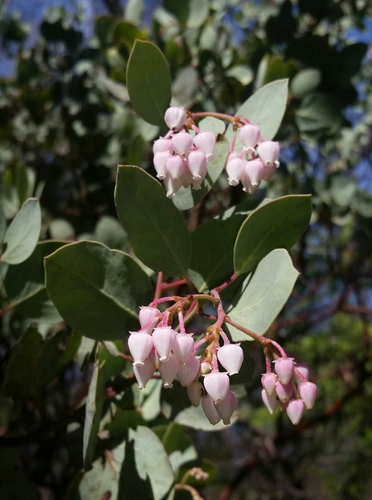
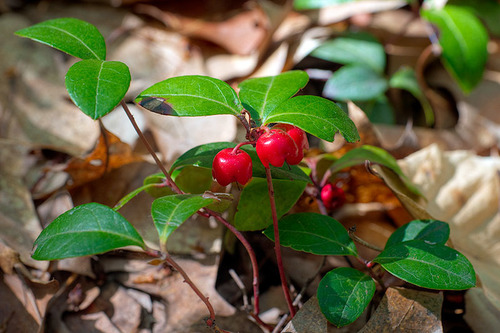
Gaultheria procumbens L., commonly known as eastern teaberry, checkerberry, boxberry, or American wintergreen, is a species in the genus Gaultheria of the Ericaceae (heath family). It is native to northeastern North America, ranging from Newfoundland west to southeastern Manitoba, and south to Alabama. This is a small, low-growing shrub that typically reaches 10 to 15 centimeters (4 to 6 inches) in height. Its leaves are evergreen, shaped elliptic to ovate, and measure 2 to 5 centimeters (3⁄4 to 2 inches) long by 1 to 2 centimeters (1⁄2 to 3⁄4 inches) broad, with a distinct oil of wintergreen scent. The pendulous flowers have a white, sometimes pink-tinged, bell-shaped corolla 8 to 10 millimeters (0.31 to 0.39 inches) long with five teeth at the tip, and a white calyx above the corolla. Flowers grow from leaf axils, usually one to three per stem. The anthers are forked in a shape similar to a snake's tongue, with two awns at the tip. The fruit is a red epigynous berry 6 to 9 millimeters (0.24 to 0.35 inches) across; most of the fruit's flesh is made up of the fleshy calyx. G. procumbens is a calcifuge that prefers acidic soil in pine or hardwood forests, though it generally only produces fruit when growing in sunnier areas. It often grows as part of the heath complex in oak-heath forests. It spreads via long rhizomes that grow within the top 2 to 3 centimeters (3⁄4 to 1+1⁄4 inches) of soil. Because its rhizomes are so shallow, most forest fires kill the plant, but brief or mild fires may leave the rhizomes intact, allowing the plant to regrow even if the above-ground portion is burned away. This plant has been awarded the Royal Horticultural Society's Award of Garden Merit. Various Native American tribes have used this plant for medicinal purposes. The Delaware, Mohicans, and several other tribes made tea from its leaves to treat kidney disorders. Tribes of the Great Lakes and Eastern Woodlands used wintergreen poultices as a topical treatment for arthritic pain.