About Gaultheria hispidula (L.) Muhl. ex Bigelow
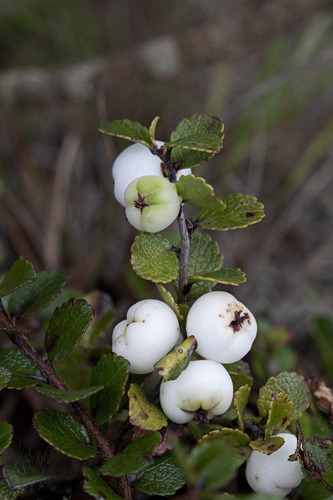
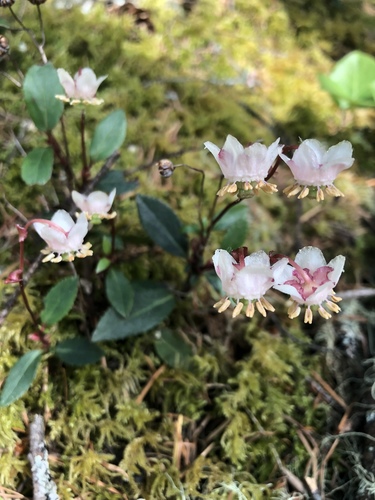
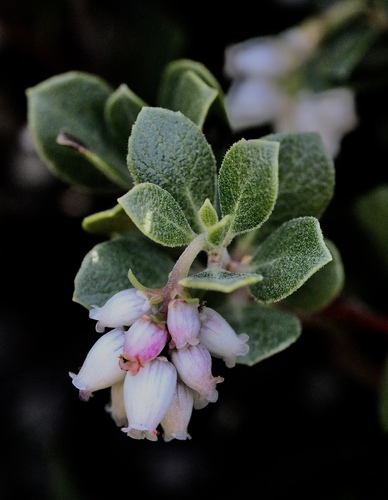
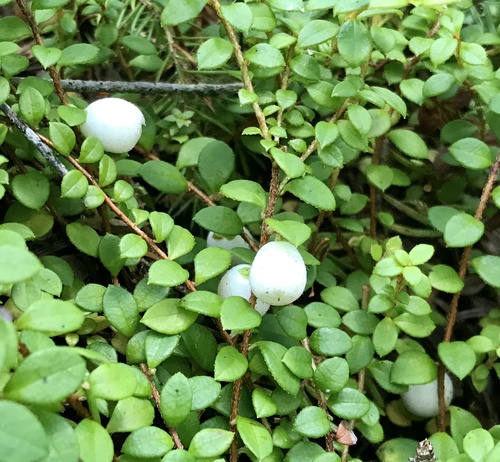
Gaultheria hispidula (L.) Muhl. ex Bigelow is an evergreen prostrate shrub that forms a mat of stems and leaves, reaching up to 1 m (3+1⁄2 ft) in diameter and only 10 centimetres (3.9 in) in height. Its small leaves, which measure under 1 cm (0.39 in) long, are arranged alternately along the stems. Both the stems and the undersides of the leaves are covered with stiff hairs. Pale green-white flowers typically bloom between May and June, and fruits ripen between August and September. Flowers grow on short, nodding stalks in the leaf axils. Each bell-shaped flower has four sepals and four petals fused at the base, ending in slightly flared lobes. Like other Gaultheria species, its flowers are bisexual, with eight short stamens that do not extend past the corolla. The actual fruits are capsules, surrounded by a persistent, fleshy white calyx that gives the structure the appearance of a small white berry. The surface of this fruit-like structure is also covered with short dark-red bristles. The edible fruit has an acidic, wintergreen-like taste. Gaultheria hispidula grows in acidic and neutral soils in open woodland and forest verges, particularly on wet ground such as in or on the edge of bogs, and often grows near tree stumps. Its original range extended from far northern Canada to as far south as North Carolina, but it has been extirpated from the southern portions of its original range. It is pollinated by solitary bees, bumblebees, bee-flies, and hoverflies, while chipmunks and deer mice spread its seeds. Multiple Indigenous groups have traditional uses for this plant: The Algonquin people use an infusion of the leaves as a tonic for overeating, and also use the fruit as food. People of Anticosti use it as a sedative. The Mi'kmaq prepare a decoction of the leaves or the whole plant for an unspecified purpose. The Ojibwa people use the leaves to make a beverage. Etymologist Frederic Cassidy hypothesized that the medicinal uses of this "moxie-plum" (or another similarly named plant) inspired the name of the 1870s patent medicine and later soft drink Moxie. Beyond traditional uses, the leaves can be cooked and eaten as a vegetable. The fruits can be eaten raw, baked, or used to make jam.