About Gaultheria crassa Allan
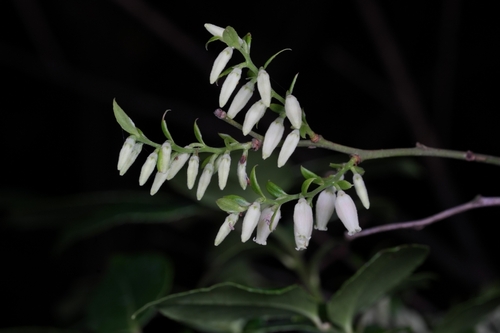
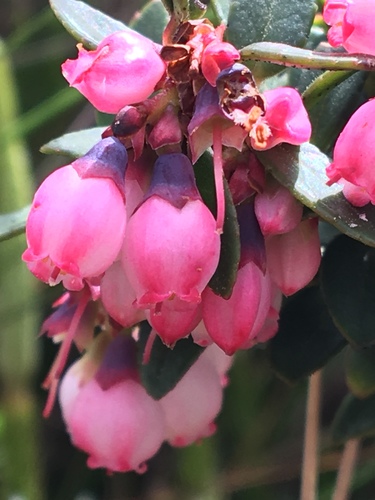
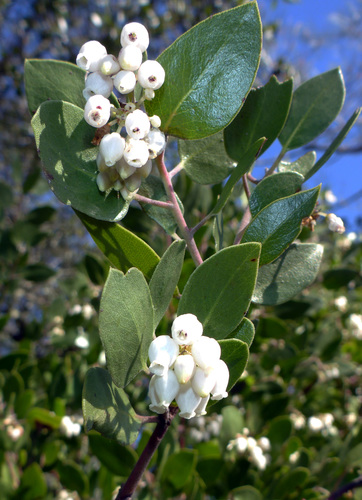
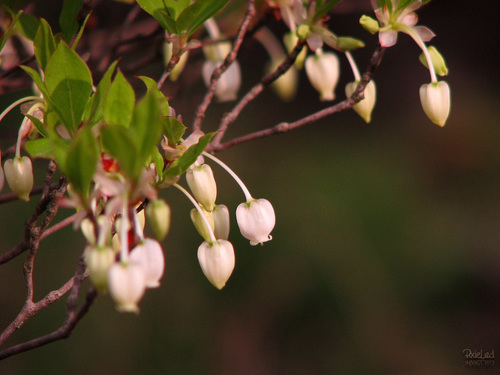
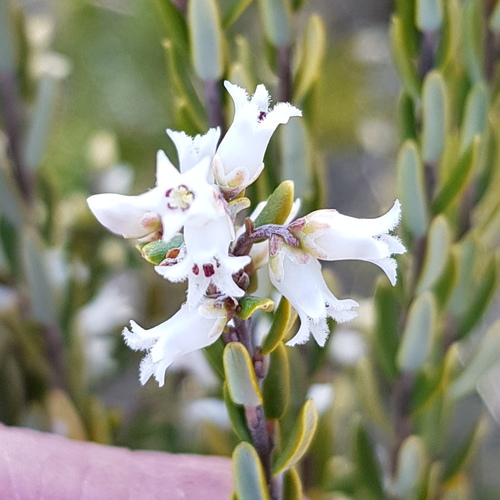
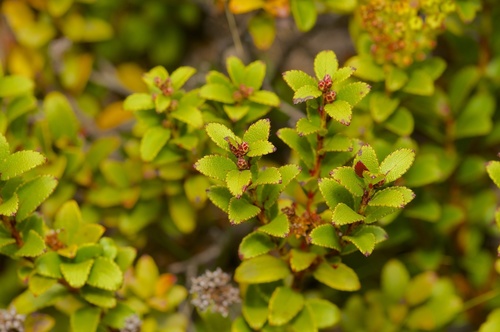
Gaultheria crassa Allan is a small, branched shrub that reaches 1–2 meters in height. Its specific epithet crassa comes from the Latin word crassus, meaning thick, fleshy, dense or fat, a reference to the species’ characteristic leaves. The leaves are thick, narrow and elliptical in shape, and small in size, measuring 10–15 mm long and 5–7 mm wide. Leaf edges are subtly toothed, and leaves have a rounded base. Their color is browny green, and they grow in an alternate arrangement along branchlets. Petioles are short and red. Branches are pale green, and both branches and stems are covered in small, sparse black hairs. This sparse hair covering distinguishes G. crassa from its closest relative, Gaultheria rupestris, which has a much denser covering of hairs. G. crassa produces pale white, bell-shaped flowers; both the corolla and calyx are white. Individual flowers are approximately 3 mm long, with tiny hairs covering the inside of the flower that create a downy texture. Flowers grow in clusters on terminal racemes, which are typically around 8 cm long. The calyx is non-fleshy, and seeds develop inside a dry 2 mm diameter capsule that is segmented into five parts. G. crassa is endemic to New Zealand, occurring in southern areas of the country from the Ruahine Range in the North Island down the full length of the South Island. It is abundant in subalpine and alpine scrub and shrubland on the eastern side of the South Island’s mountain ranges. It is common in Aoraki / Mount Cook National Park, and is most widespread in Canterbury alpine regions. Populations in the Craigieburn Range, Lake Lyndon, Cass and Otira Valley in Arthur’s Pass National Park have been studied for research. This species prefers rocky areas and open scrub in the mountains of New Zealand’s South Island, growing at altitudes between 700 m and 1700 m, indicating a preference for the colder conditions of alpine environments. It is often an early colonizer of stable moraine sites, where glacial debris creates ideal habitat of loose rocks with low competition. It prefers drier terrain, so it is more common on the drier eastern side of the Southern Alps. This preference contrasts with its close relative G. rupestris, which is more abundant in the wetter areas of the West Coast mountain ranges. In the species’ southern locations, habitat soils are mostly derived from greywacke sandstone. In the North Island, G. crassa occurs on the eastern side of Mount Ruapehu, where soils are mostly a mixture of volcanic sand and gravel. In the Cass area, G. crassa grows alongside other shrub species, where the local soil type has been recorded as strongly leached high-country yellow-brown earth. The average yearly temperature in the Cass area is 9 °C, with an average annual rainfall of 130 cm. Conditions here are variable, with dry warm summers and wet cold springs, which demonstrates that areas where G. crassa grows can have extreme seasonal variability in both rainfall and temperature. The wide range of conditions the species tolerates indicates it is a variable and persistent species. Small clusters of G. crassa’s creamy bell-shaped flowers appear between October and December. Flowering occurs in a sequential succession alongside other scrub species in local plant communities; in one documented community, flowering begins first with Corokia cotoneaster, followed by G. crassa, and then by Discaria toumatou. The flowers are visited by many insects, and serve as a major source of pollen and nectar for insects in alpine and subalpine plant communities. Flowers develop into fruits from January to April. Unlike other species in its family, G. crassa does not produce fleshy fruit. The calyx remains dry in mature fruit, and seeds develop in large quantities inside the dry capsule. These small, numerous seeds are wind-dispersed, an adaptation that suits the harsh, unstable conditions of moraine habitats, where frequent disturbance from shifting rocks is common. G. crassa seeds are pointed in shape, measuring 0.50–0.90 mm in length, with outer seed coats ranging in color from pale yellow-orange to dark brown or henna. Species in the genus Gaultheria produce long-lived seeds that form a persistent seed bank. Studies show that germination of G. crassa seeds is usually delayed by 2–3 weeks, and germination proceeds readily after this delay. Light is required for germination, and seeds have been recorded to remain viable for up to 12 months, with reduced germination rates after 16 months.