About Gastrophysa viridula (De Geer, 1775)
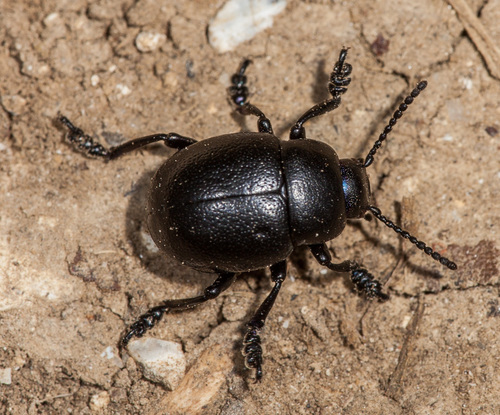
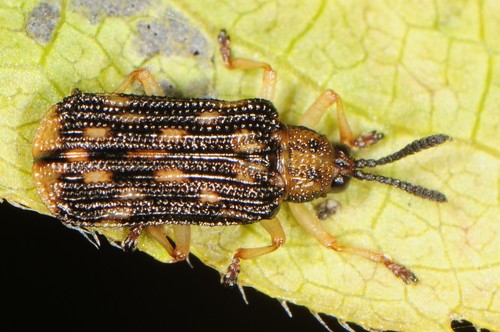
This species, commonly called the green dock beetle, has a body length that differs between sexes: males reach 4 mm long, while females reach 7 mm long. Females develop enlarged abdomens during the mating season. Both sexes are green with a metallic shimmer that can appear gold-green, blue, purple, violet, or red depending on lighting. The species has strongly built legs that also have a metallic green shimmer, and medium-length serrated antennae. The green dock beetle is common in central Europe, and is also common and widespread across Britain. Its range extends east to western Siberia and the Caucasus Mountains. It inhabits heathlands, forests, meadows, and gardens where its food plant, dock (Rumex), grows. The breeding season of the green dock beetle runs from March to October. The species produces 2 to 4 broods each year, and the final brood of the year hibernates in the adult stage. A female can lay over 1,000 eggs total, depositing them in clusters of 20 to 45 on the underside of its food plant's leaves. The eggs are oval, and are cream to yellow in color, turning orange just before hatching. Larvae hatch 3 to 6 days after eggs are laid. Larvae range in color from greenish gray to dark brown, have segmented bodies, and grow up to 8 mm long. If disturbed while feeding, young larvae will drop to the ground, while older larvae secrete a substance that repels competing insects from the food plant's leaves. After going through three larval instars, the larva pupates in a burrow around 2 cm underground. Adults emerge 6 to 9 days after pupation starts. The green coloration of this beetle comes from a multilayer structure of alternating chitin and melanin-containing layers, an effect called structural colour. The development of this structure has been studied using advanced imaging techniques, which show the multilayer forms during pupation and sclerotisation.