About Gastrolobium grandiflorum F.Muell.
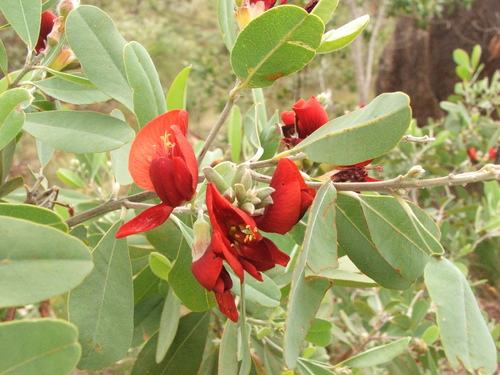
Gastrolobium grandiflorum, commonly called wallflower poison, wallflower poison bush or heart-leaf poison bush, is a bushy shrub endemic to Australia. It reaches a height of 2 to 3 metres. Between late summer and early winter (February to August in Australia), it produces orange-red pea-shaped flowers that have a yellow centre and red veins. Young plants of this species have hairy, heart-shaped leaves, while older plants have elliptical, more hairless leaves; leaves can grow up to 6 centimetres long and 2.7 centimetres wide. The species was first formally described by botanist Ferdinand von Mueller, and the description was published in Fragmenta Phytographiae Australiae in 1863. It is the most geographically widespread species in its genus, found across a large area of Queensland, as well as in the Northern Territory, Western Australia and South Australia. Like many other species in the genus Gastrolobium, this species contains high levels of fluoroacetate, which is the active ingredient in the pest control toxin called 1080. Its leaves, seeds and roots are highly poisonous to cattle, sheep, horses and goats. Major livestock losses in Queensland have been linked to this plant. In 1896, explorer and gold prospector David Carnegie encountered this plant in Western Australia during the return leg of his expedition from Coolgardie to Halls Creek. He later wrote an account of the encounter: "All along the banks of the creek splendid green acacia and grass was growing, and a most inviting-looking plant standing some six feet high, with greenish-grey stems and leaves, and a flower not unlike wallflower. Such a place at once suggested camping, and we were proceeding to unload when Godfrey remarked that this pretty plant was very like a most deadly Queensland poison plant; he was not sure; I had never seen it before, nor had Breaden. The risk, however, was too great; it might be poison; I could see the camels eyeing its fresh charms, and it grew in such profusion that all would be devouring it in a few minutes. So we packed up again and moved further on, much to the disgust of the blacks and the animals, for all were very tired. I collected some specimens of this plant; if Godfrey had never been in Queensland we should have been in a tight corner." Because the plant is so toxic to domesticated farm animals, after bushfires, cattlemen in north-western Queensland must move their livestock before heart-leaf poison bush sprouts from the ash.