About Gastrodia sesamoides R.Br.
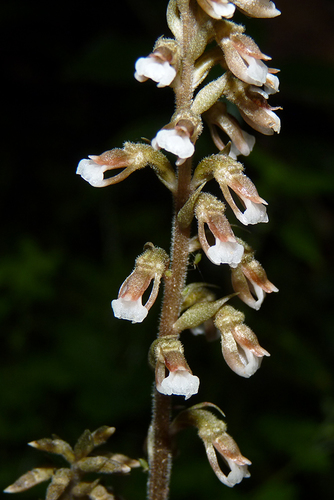
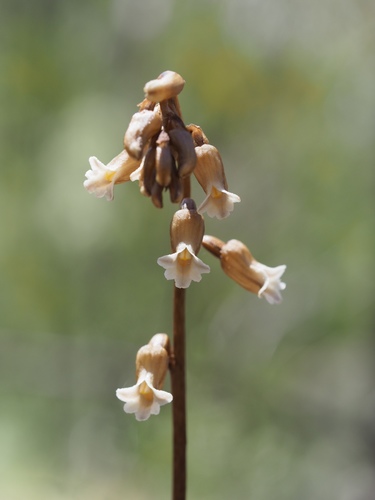
Gastrodia sesamoides R.Br. is a leafless, terrestrial saprophyte with an underground rhizome that grows up to 80 mm (3 in) long and 30 mm (1 in) in diameter. It produces a thin, fleshy brown flowering stem 12–75 cm (5–30 in) tall, which carries between three and six bracts 4–10 mm (0.2–0.4 in) long, and between three and twenty five individual flowers. The flowers are cinnamon brown to greyish brown, often rough on the outside, and white inside. Their sepals and petals are joined to form a bell-shaped tube 15–20 mm (0.6–0.8 in) long. Each flower has a stalk (pedicel) 2–10 mm (0.08–0.4 in) long and a cone-shaped ovary with the narrower end pointing toward the base. Flowers often produce a pleasant, cinnamon-like scent. Flowering occurs from September to January in Australia and from August to May in New Zealand, and the flowers are self-pollinating. Flowering is enhanced when fire occurs in the previous summer. This species, commonly called cinnamon bells or potato orchid, is widespread and common. In Australia, it occurs south from the Darling Downs, through the eastern half of New South Wales and the southern half of Victoria, to Tasmania. It was historically found in the Sydney region but is now considered rare or extinct there. It is only found in the far southeast of South Australia, including on Kangaroo Island. In New Zealand, it occurs on both the North Island and the South Island, though on the South Island it is restricted to the Marlborough and Nelson areas. It grows in a wide variety of habitats, including forest and coastal scrub, from lowland to subalpine areas, as long as there is adequate rainfall or soil moisture. In New Zealand, it is often found in forestry plantations and in gardens where pine bark mulch is used. Because this orchid does not produce chlorophyll, it cannot make its own food through photosynthesis. Instead, it forms a complex relationship with a fungus. The orchid gets its nutrients from the fungus, while the fungus gains its habitat from the orchid, plus minerals and sugars from the roots of other forest trees. Gastrodia sesamoides has been introduced to South Africa, where it is now naturalised. Indigenous Australians ate the roasted tubers of this orchid, and it may have been one of the principal plants used by Tasmanian Aborigines. An early Victorian settler reported that Aboriginal peoples located these plants by observing where bandicoots had scratched in search of the tubers, after the bandicoots detected the underground plants by scent. The flavour of the tuber is described as similar to beetroot, though it is insipid and watery. Cultivation of Gastrodia sesamoides has not been achieved yet. However, cultivation of other Gastrodia species has been successful, and the methods used for those species could be adapted to cultivate Gastrodia sesamoides in the future.