About Gasteria obliqua (Aiton) Duval
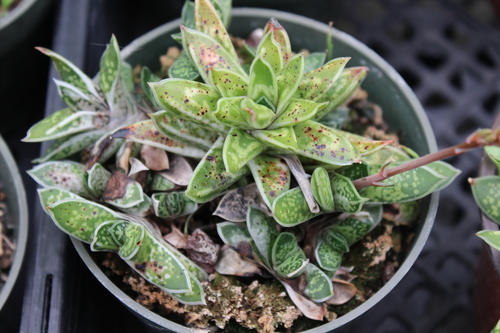
Gasteria obliqua (Aiton) Duval, also referred to as Gasteria bicolor, is a highly variable Gasteria species that is common in cultivation. It produces multiple proliferous stems, all covered in untidy clusters of shiny, mottled, colourful succulent leaves. It usually grows in rosettes, but can sometimes be distichous, especially when grown in cultivation. Its leaves may occasionally develop a keel, and each leaf has a sharp point at its tip. Flowers typically grow on a long stem around 30 cm (12 in) long, which bears tubular bell-shaped flowers that range in colour from pink to orange. There are three major varieties that grade into one another. The first is Gasteria bicolor var. bicolor (Haw.), the more widespread type variety. The second is Gasteria bicolor var. fallax (Haw.), a variety with narrow, elongated, linear, mottled leaves measuring approximately 140 x 11mm. Dense clumps of this variety are found in Albany thickets near Swartwaterspoort. The third is Gasteria bicolor var. lilliputana (Poelln.), which was previously classified as the separate species Gasteria liliputana. It is the smallest variety in the entire Gasteria genus, with rosettes around 3 inches (7.6 cm) wide. Its foliage is dark green with white spots, it is relatively rare, and it occurs naturally in the Grahamstown area. In the wild, G. bicolor grows across a wide area of the Eastern Cape. Its natural habitat is typically rocky slopes and outcrops within the region's thicket vegetation, and it is especially common around Port Elizabeth, which is a summer rainfall region. Its natural range overlaps with the ranges of several other Gasteria species. This species is popular in cultivation, though it grows slowly. It prefers well-drained, rich soil and summer watering. It is only hardy down to 5 °C (41 °F), so it must be grown under glass during winter in temperate regions. Its cultivation requirements are similar to those of other succulents and cacti. The variety G. bicolor var. lilliputana has received the Royal Horticultural Society's Award of Garden Merit.