About Gasteria acinacifolia (J.Jacq.) Haw.
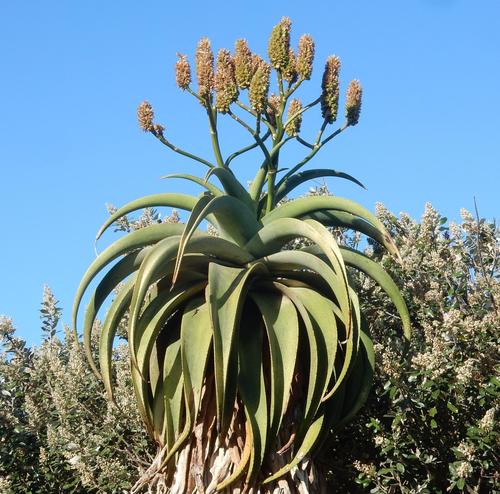
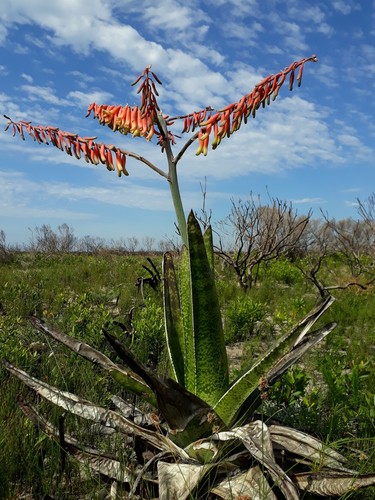
Gasteria acinacifolia (J.Jacq.) Haw. is the tallest species in the Gasteria genus, growing even larger than its close eastern relative Gasteria excelsa. It forms rosettes of light-green, sharp, stiff leaves covered in spots, that can reach up to 1 meter in length. Its species epithet acinacifolia means "scimitar-leaves", referring to the curved shape of smooth mature leaves that end in a sharp point. The multi-branched inflorescence of this species often grows over one meter tall, bears pink flowers, and appears between September and December. Unlike the inflorescence of Gasteria excelsa, Gasteria acinacifolia's inflorescence is flat-topped, with racemes that spread horizontally. Gasteria acinacifolia can be confused with the eastern species Gasteria excelsa, but G. excelsa has thicker, wider, straighter, smoother, darker leaves that have fewer spots and much sharper, heavily serrated margins, as well as a more erectly branching inflorescence. It can also be confused with the western species Gasteria carinata, but typically formed G. carinata has much smaller leaves and an unbranched inflorescence. Like most Gasteria species, juvenile G. acinacifolia plants look very different from adult plants. Juveniles have a distichous (two-ranked) leaf arrangement, with tubercled, strap-shaped, blunt leaves. Adults form rosettes of extremely long, smooth, sharply-pointed scimitar-shaped green leaves, which are extremely densely covered in bands of tiny white spots. The leaves also have rough partial margins. This species grows on shady cliff faces and in dune thickets along the coast, between Knysna and Port Alfred in the Eastern Cape, South Africa, an area that receives moderate rainfall year-round. It is often cultivated for coastal gardens, or grown as a container plant.