About Gasteracantha westringi Keyserling, 1864
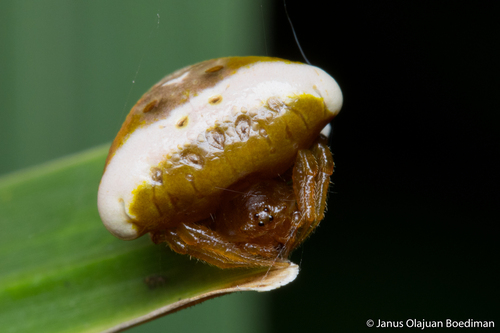
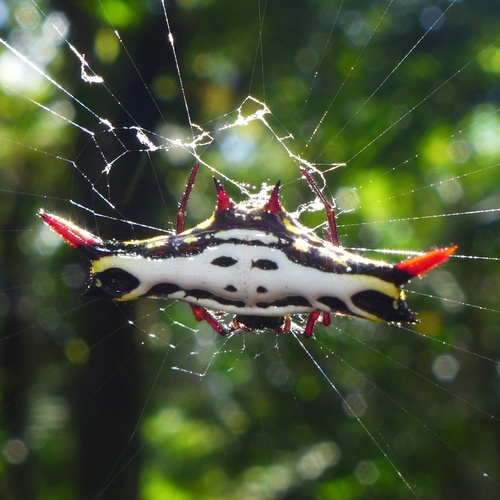
Female Gasteracantha westringi have hard, shell-like abdomens that are roughly three times as wide as they are long. Without including spines, the abdomen is about 13 millimeters wide and 4 millimeters long, and flares upward at both ends to resemble a pair of wings. The abdomen has three pairs of spines. The front anterior pair is short, around 1 millimeter long, black, and points slightly forward. The middle median pair is black at the base, red along most of its length, and ends in a black tip. These median spines are approximately 4.5 millimeters long, and curve backward and slightly downward. The rear pair of spines is around 2 millimeters long. Female abdomens are marked with sunken black sigilla. On the upper surface, the front edge of the abdomen holds 10 sigilla arranged in a curved row: the four middle sigilla are relatively small, while the outermost sigilla are large and egg-shaped. These larger outer sigilla can also be seen on the underside of the abdomen. Four sigilla form a trapezoid shape in the center of the upper abdomen, and an additional row of sigilla follows the posterior edge. The sigilla may be surrounded by pale yellow coloring. The male of this species has never been scientifically described. In terms of taxonomy and distribution, the first scientific description of this species, published by Keyserling in 1864, did not record a place of origin for the species. In 1865 and 1871, similar descriptions were published based on specimens collected from New Caledonia (described as G. laeta) and Australia. In 1871, Koch also described a species from New Caledonia that he named G. mollusca, noting that the specimen he studied may have been a freshly molted individual. In 1889, A.T. Urquhart published a description of an orb-weaver from Norfolk Island, which he named G. ocillatum. Urquhart noted that it was very similar to G. westringi, but did not explain why it should be considered a separate species. In 1914, Friedrich Dahl provisionally grouped all of these previously described forms under the single name G. westringi, and stated that further regional research was needed to clarify the status of these different forms. In 1911, Embrik Strand briefly named a new species, G. wogeonis, from Vokeo in the Schouten Islands (Papua New Guinea). Strand wrote that it could be distinguished from G. westringi by its shorter spines and smaller sigilla. Apparently based only on this comment, Dahl also provisionally synonymized G. wogeonis with G. westringi, without adding any specific additional comment. However, in 1915, Strand published a more detailed description and an illustration of G. wogeonis that showed a form with small spines, reddish coloring, and less elongation, which is quite different from any of the other descriptions of taxa Dahl included in G. westringi.