About Gasteracantha hecata (Walckenaer, 1841)
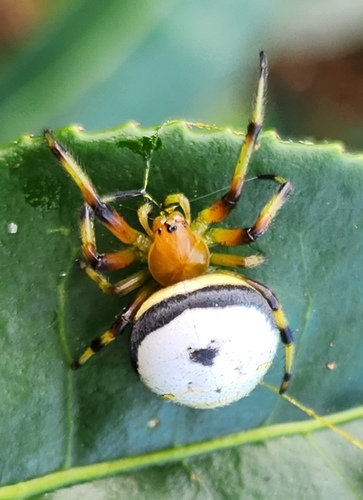
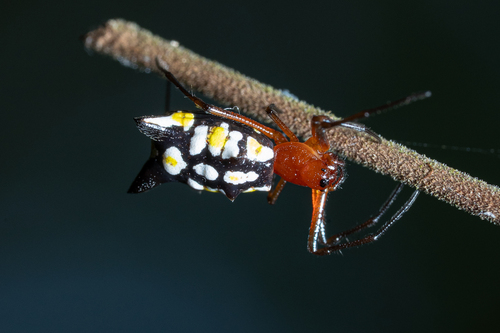
Female Gasteracantha hecata orb-weavers have hard, shiny yellow-and-black abdomens that are about twice as wide as long, and are armed with two pairs of spines. The anterior pair is tiny and sharply pointed, while the second pair is long, horn-like, and covered with short bristles. These spines curve gently backward, giving the spiders a crescent-like shape. Unlike most Gasteracantha species, which have six spines, this species notably lacks a third pair of spines on the posterior edge of its abdomen. The male of this species has not been scientifically described. Charles Athanase Walckenaer described this species in 1841, originally under the name Plectana hecata, based on drawings and notes from James Petiver's early 18th-century Gazophylacium naturae et artis. Petiver had based his own work on designs sent to him from Luzon by Czech Jesuit and naturalist Georg Joseph Kamel. In 1844, Carl Ludwig Koch described and illustrated a species he called Gasteracantha falcifera from a single specimen housed at the natural history museum in Berlin. By 1914, there were several specimens of this spider in Berlin, and Friedrich Dahl determined that the descriptions from Petiver, Walckenaer, and Koch, as well as the specimens he examined himself, should all be treated as the single species Gasteracantha hecata. Gasteracantha hecata occurs in the Philippines. In 1914, Friedrich Dahl noted specimens from Manila, Luzon, and Samar in the Natural History Museum, Berlin collection.