About Gardenia volkensii K.Schum.
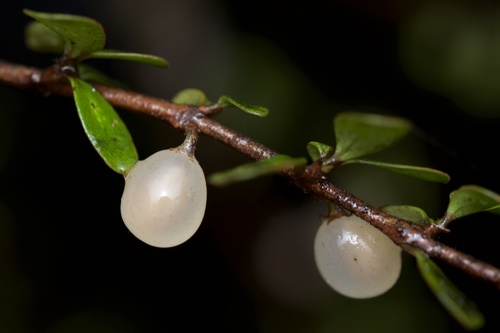
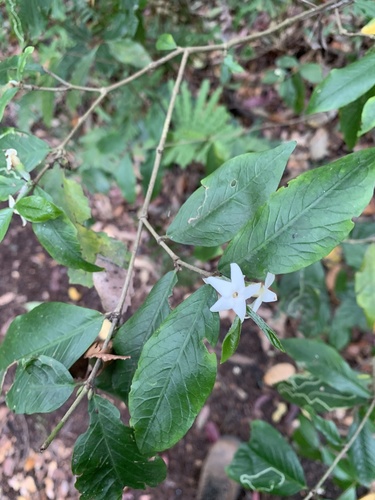
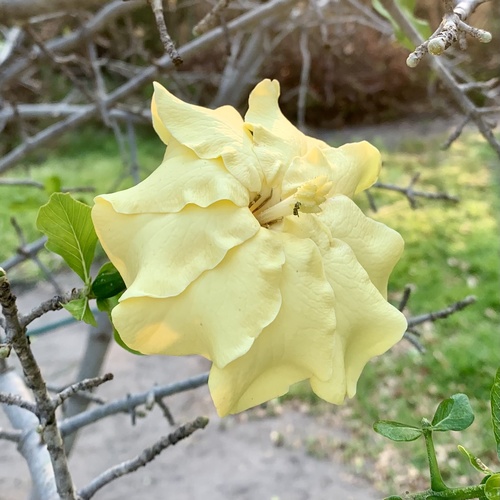
Gardenia volkensii K.Schum. is a multi-stemmed shrub or small tree with short, rigid branches. Its branches form a dense, rounded canopy that may reach all the way to the ground. It has pale grey bark. Shiny, spoon-shaped leaves grow in clusters at the ends of knobbly branchlets. Its trumpet-shaped flowers are white when they first open, and turn yellow as they age. After flowering, it produces large, round, hard fruits. The ribbed outer layer of the fruit is grey, and it encloses an orange pulp that holds the plant’s seeds.
Within South Africa, there are two recognized subspecies of Gardenia volkensii, which can be distinguished by their fruit. Gardenia volkensii subsp. volkensii produces larger, paler fruit that is more heavily ribbed, and its fruit surface bears white spots called lenticels. The fruit of G. volkensii subsp. volkensii var. saundersiae is smaller, darker, and smoother. G. volkensii subsp. spatulifolia is also a recognized taxon.
This species grows in bushveld habitats across tropical and southern Africa, and has been recorded in 14 countries: Angola, Botswana, Eswatini, Ethiopia, Kenya, Malawi, Mozambique, Namibia, Tanzania, Uganda, Somalia, South Africa, Zambia, and Zimbabwe. Ecologically, individual plants are often found growing in association with termite mounds. Its leaves are eaten by livestock and wild animals, including giraffe and kudu. Leaves also provide important resources for insects, including Carlisis wahlbergi and the caterpillars of Deudorix dinochares. The plant’s scented flowers open at night, and are most likely pollinated by moths. Whole fruits of Gardenia volkensii are eaten by people in Mozambique and Ethiopia.
Gardenia volkensii is often planted near villages to protect settlements from lightning, and it is also believed to offer protection against evil spirits. Its hard, fine-grained wood is used for carving. This species has been used medicinally to treat a range of conditions in at least eleven of its naturally occurring range countries. Medicinal uses include treating respiratory infections such as asthma and tuberculosis in Botswana, Eswatini, Namibia, South Africa, and Zimbabwe; menstrual problems in Zimbabwe; infertility in Kenya and Zimbabwe; gastro-intestinal problems in Eswatini, Mozambique, and Namibia; and epilepsy in Botswana, Eswatini, Kenya, South Africa, and Namibia, among other conditions. It is also used as an antivenom and to treat cancer. Extracts from the plant’s fruits and bark have been found to have anti-microbial properties.