About Gardenia taitensis DC.
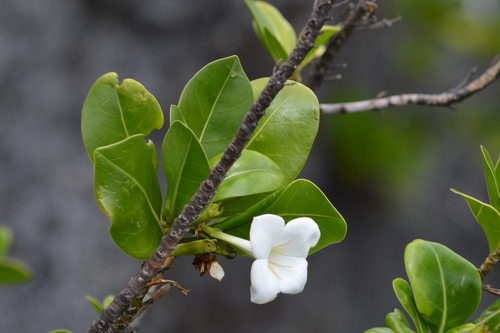
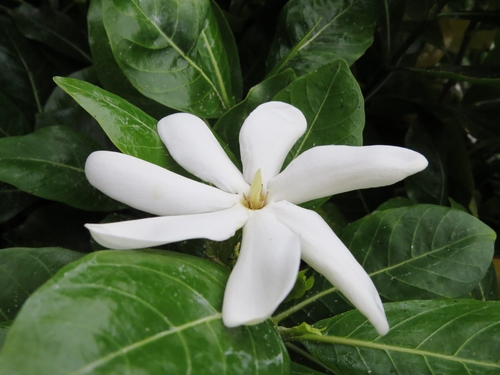
Gardenia taitensis DC., commonly known as Tahitian gardenia or tiaré flower, is a plant species in the family Rubiaceae. This evergreen tropical shrub grows up to 4 meters (10 feet) tall. It has glossy dark green leaves that measure 5–16 cm (2–6 inches) long and arranged oppositely along its stems. The plant produces fragrant creamy white pinwheel-shaped flowers with 5–9 lobes; each lobe is 2–4 cm (0.8–2 inches) long. It is native to the highland shores of the South Pacific, and is one of the few cultivated plant species that are native to Polynesia. It is the national flower of both French Polynesia and the Cook Islands. The common name Tahitian gardenia is considered a misnomer, as the species is neither native nor naturalized in Tahiti. The first accepted scientific name for this plant was based on Tahitian specimens collected by Jules Dumont d'Urville in 1824, which led to its scientific name Gardenia taitensis, and its common names Tahitian gardenia and Tiaré flower. It was first collected in Tahiti by the Forsters during Captain Cook's first Pacific voyage from 1768 to 1771, but it was misidentified at the time as Gardenia jasminoides. The species originates from Melanesia and Western Polynesia, and was introduced by Indigenous peoples to the Cook Islands and French Polynesia, and possibly to Hawai’i. This plant is used in traditional herbal medicine. For example, in Tonga, an infusion made from its bark is dripped into the nose, eyes, and mouth to treat "ghost sickness". In Samoa, parts of the plant are used to treat inflammation.