About Gardenia jasminoides J.Ellis
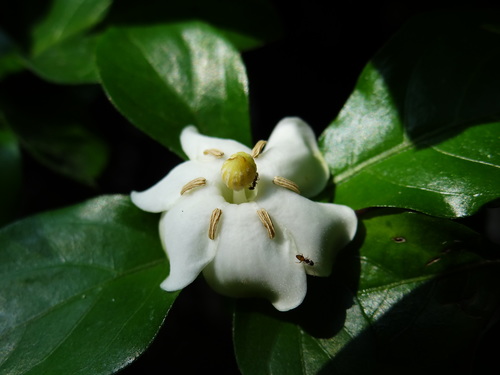
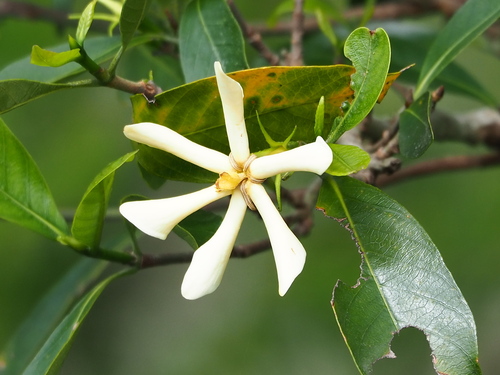
Gardenia jasminoides J.Ellis is a wild shrub that grows 30 cm to 3 m (1–10 ft) tall. Its branches are cylindrical to flattened, initially covered with early-falling caducous hairs that leave the branches smooth. Leaves grow in opposite pairs, or rarely in groups of three, along the branches. They are either almost stalkless (subsessile) or attached to short petioles that measure 0.5–1 centimetre (0.2–0.4 inches) long. Leaf blades are 3–25 cm (1.2–9.8 in) long by 1.5–8 cm (0.6–3.1 in) wide, and can be oblong-lanceolate, obovate-oblong, obovate, oblanceolate, or elliptic in shape. The upper leaf surface is smooth and shiny, or slightly hairy along the primary veins, while the lower leaf surface ranges from sparsely hairy to smooth. Each leaf has 8 to 15 pairs of secondary veins. Flowers are solitary and terminal, growing from the ends of stems. The flowers are white with a matte texture, which contrasts with the plant’s glossy leaves. Over time they develop a creamy yellow color and waxy surface. Flowers can grow quite large, reaching up to 10 cm (4 in) in diameter, are loosely funnel-shaped, and double-flowered forms exist. Blooming occurs in summer and autumn, and the flowers are among the most strongly fragrant of all flowers. All flowers of this species (commonly called jasmine gardenia) are simultaneous hermaphrodites. After flowering, the plant produces small, oval fruits.
Gardenia jasminoides is native to southern East Asia, mainland Southeast Asia, and northeastern South Asia, including the following regions and countries: Bangladesh, Cambodia, East Himalaya, Hainan, Japan, Laos, mainland China, Taiwan, Thailand and Vietnam. Its native habitat is forest and undergrowth along streams, on sloping and hilly terrain up to an altitude of 1,500 metres (4,900 feet). The species has been introduced to other regions with suitable climate and habitat: the Caroline Islands, Comoros, Korea, Marianas, Marshall Islands, Society Islands and Tubuai Islands.
Evidence of G. jasminoides cultivation in China dates back to the Song dynasty (960–1279 AD), when both single- and double-flowered forms were depicted in paintings, including works by Song emperor Huizong and 10th-century artist Xu Xi. It appeared on Yuan dynasty (1271–1368) lacquerware, and Ming dynasty (1368–1644) porcelain. Known as zhi-zi in traditional Chinese medicine, it was used as a folk remedy for jaundice, oedema and fevers.
English statesman Sir John Barrow observed gardenias in Guangzhou, China nurseries in 1794. G. jasminoides reached Europe by way of the Cape Colony in southern Africa, which was founded in 1652 as a way-station between the Netherlands and Asia. There, Daniel Des Marets, Superintendent of the Dutch estates of William III, collected plant material that ended up in the herbarium of English naturalist Hans Sloane in the 1680s. Swedish naturalist Daniel Solander recorded that living G. jasminoides was brought to the United Kingdom (UK) from the Cape Colony in 1744 on the British East India Ship Godolphin by Captain William Hutchenson, who gave the plant to botanist Richard Warner of Woodford Row, Essex. The plant reportedly remained in flower for most of the voyage. Warner could not propagate the plant until botanist John Ellis recommended James Gordon, a gardener at Mile End. Gordon successfully propagated the plant in August 1757, after which the plants sold well; each cutting-grown plant sold for five guineas.
Gardenias were first grown in the United States in 1762, in Garden’s Charleston garden; Garden had moved to Charleston 10 years prior. In UK cultivation, Gardenia jasminoides has earned the Royal Horticultural Society's Award of Garden Merit. It is highly valued for its fragrant summer flowers and attractive foliage, and is used as a specimen feature or as a hedging or screening plant. It is widely grown as a garden plant in warm temperate and subtropical gardens, and is hardy in USDA hardiness zones 8 to 10, or UK zone H1C (where outdoor temperatures stay above 5 °C (41 °F)). It requires good drainage, a sunny or part-shaded location, and prefers acidic soil with a pH between 5.0 and 6.5. In temperate latitudes, gardenias are usually grown as houseplants or in greenhouses. If the soil is not acidic enough, many nutrients (especially iron compounds) will not be available to the plant, as they will not dissolve in water and cannot be absorbed by the roots. This causes gardenias to develop chlorosis, the main symptom of which is yellowing leaves. Iron chelate can be added to soil to lower the pH, and may need to be added repeatedly if the water supply is hard.
Gardenia flowers can be eaten raw, pickled, or preserved in honey. In China, petals are added to tea for their aroma, while a yellow-red dye used in textiles and sweets is extracted from the fruit pulp. Gardenia jasminoides fructus (dried fruit) is used in traditional Chinese medicine to "drain fire" and treat certain febrile conditions, and has anti-inflammatory and antipyretic effects. Shishihakuhito, a Chinese herbal medicine primarily made from gardenia fruit, is used to treat atopic dermatitis, and inhibits Immunoglobulin E (IgE) mediated histamine release. In 2020, a case of blue-gray skin discoloration resulting from chronic intake of gardenia fruit extract was published in scientific literature.