About Ganoderma applanatum (Pers.) Pat.
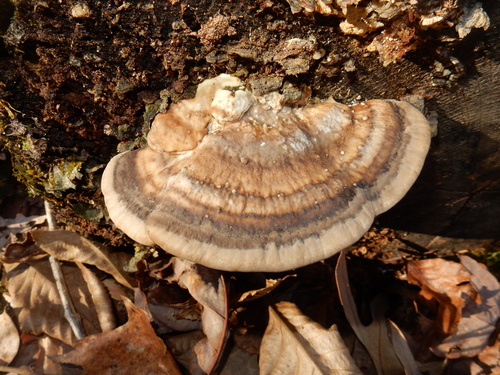
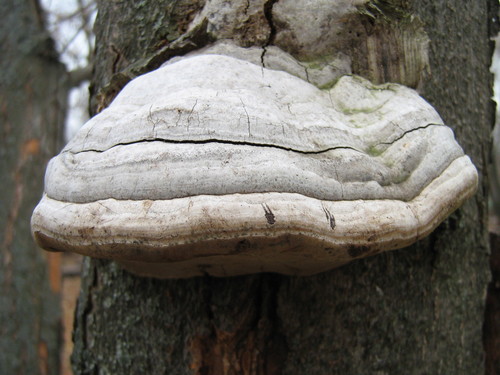
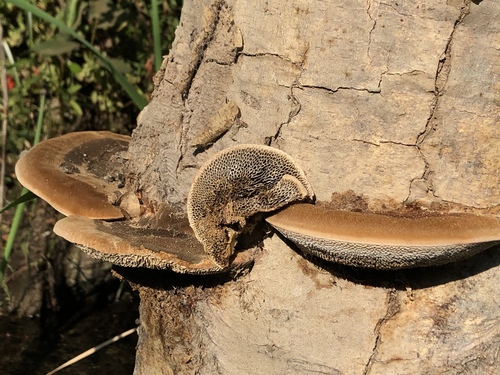
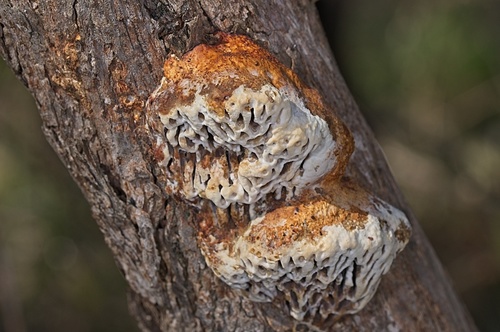
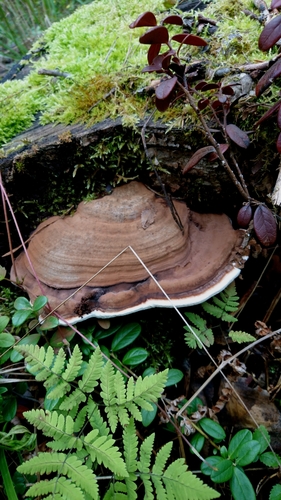
Ganoderma applanatum (Pers.) Pat. acts as both a parasite and a saprophyte, growing as mycelium inside the wood of both living and dead trees. It can grow alone, scattered across an area, or in large compound clusters. Its fruiting bodies normally measure 3–30 centimetres (1–12 inches) wide, 5–50 cm (2–19+1⁄2 in) long, and 1–10 cm (1⁄2–4 in) thick; in exceptional cases, it may grow up to 75 centimetres (30 in) across. The texture of the fungus is hard as leather and distinctly woody. The upper surface of the fruiting body is brown, covered with a reddish-brown layer. The underside is white, but turns brown when bruised or stained. Fruiting bodies are perennial, persisting for multiple years, increasing in size each year, and forming new pore layers as they grow. These growth layers can be seen in cross-section or observed as concentric rings on the fruiting body's upper surface, and the age of a fruiting body can be counted the same way as a tree's age from growth rings. Brown spores are released from the pores on the underside of the fruiting body. Spores are produced in very high concentrations: as many as 4.65 billion spores can disperse from a 10 cm (4 in) by 10 cm section of the conk within 24 hours. The pore tubes are 4–12 millimetres (1⁄8–1⁄2 in) deep, ending in round pores spaced 4–6 per millimetre. The spore print is reddish brown. As a wood-decay fungus, G. applanatum causes heartwood rot in a wide range of tree species. It can also grow as a pathogen that infects the live sapwood of trees, especially older trees that have consistently high moisture levels. It is a very common cause of decay and death in beech and poplar trees, and less commonly affects other tree genera including alder, apple, elm, buckeye, horse chestnut, maple, oak, live oak, walnut, willow, western hemlock, Douglas fir, old or sick olive trees, and spruce. G. applanatum grows more frequently on dead trees than on living trees. There are anecdotal reports that great apes consume this fungus for self-medication. In her 1983 book Gorillas in the Mist, Dian Fossey documented that gorillas eat this bracket fungus. Because the shelf-shaped fruiting body is hard to pry loose from wood, younger gorillas often have to wrap their arms and legs awkwardly around a tree trunk and can only gnaw at the fungus instead of removing it. Older gorillas that successfully free the fungus carry it hundreds of feet away from its growth site, while guarding it against attempts by more dominant gorillas to take it. Both the fungus's scarcity and the gorillas' strong preference for it cause frequent intragroup conflicts, many of which are resolved by the silverback gorilla, who simply takes the disputed fungus for himself. The midge Agathomyia wankowiczii lays its eggs on G. applanatum's fruiting body, forming galls. Female forked fungus beetles (Bolitotherus cornutus) lay their eggs on the surface of the fruiting bodies, and the larvae develop inside the fruiting bodies of G. applanatum and a small number of other bracket fungi. The fly Hirtodrosophila mycetophaga courts and mates entirely on the underside of dark bracket fungi including this species. One unique use of this fungus is as a drawing surface for artists. When the fresh white pore surface is rubbed or scratched with a sharp tool, the dark brown tissue under the pores becomes visible, creating permanent lines and shading that remain after the fungus dries. This practice is the origin of the fungus's common name. G. applanatum is cultivated as a medicinal mushroom, and is used as a flavor enhancer in Asian cuisine. Raw G. applanatum cannot be digested due to its tough, woody texture. Common preparations include adding sliced G. applanatum to hot herbal soups, or fermenting it with acidic lemon and onion to use as an umami flavor booster in fermented foods. It can also be brewed into tea. It can be used to produce amadou, a leathery, highly flammable material normally made most often from Fomes fomentarius, that can be made from several different polypore species or similar materials. Amadou has three main categories of use: starting fire, medicinal purposes, and making clothing, though it is most widely known for use in fire starting. G. applanatum has been used for medicinal purposes for thousands of years across many regions. In traditional Chinese medicine, it has been used to treat rheumatic tuberculosis and esophageal carcinoma. It is also more commonly used to ease indigestion, relieve pain, and reduce phlegm. Modern studies have confirmed that the fungus has medicinal properties including anti-tumor activity, antioxidant effects, and regulation of the body's immune system. G. applanatum is called kofuki-saru-no-koshikake (コフキサルノコシカケ) in Japan, which translates literally to "powder-covered monkey's bench", and shu-she-ling-zhi (树舌灵芝) in China, where it has been used in traditional medicine for centuries. Current research confirms G. applanatum contains compounds with potent anti-tumor, antibacterial, and anti-fibrotic properties. Research into G. applanatum generally focuses on three areas: medicinal use, phytopathology, and biotechnology. Medicinal fungi including G. applanatum are of particular interest for their antibiotic properties. Methanol extracts from G. applanatum show that fatty acids found in the fungus, such as palmitic acid, have antibacterial properties. Unlike synthetic antibiotics, these compounds extracted from G. applanatum do not cause the problems of drug resistance and unwanted side effects.