About Gambelia wislizenii (Baird & Girard, 1852)
Common Name & Dorsal Scales
Gambelia wislizenii, commonly called the long-nosed leopard lizard, has granular dorsal scales.
Base Body Color & Spots
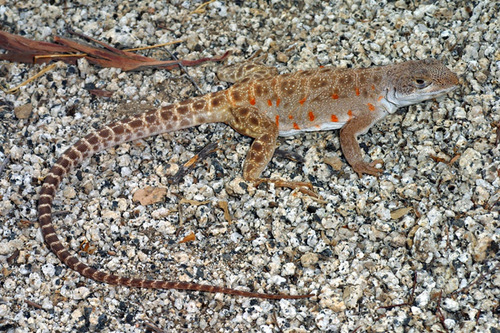
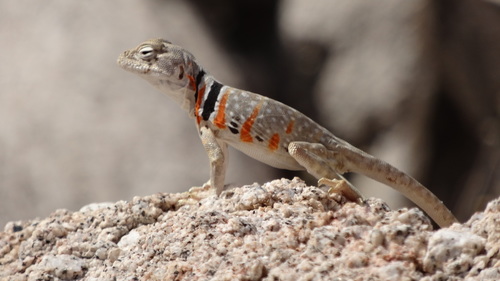
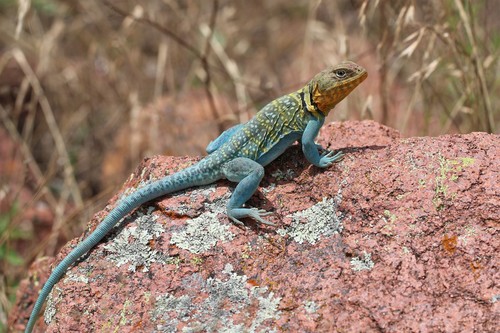
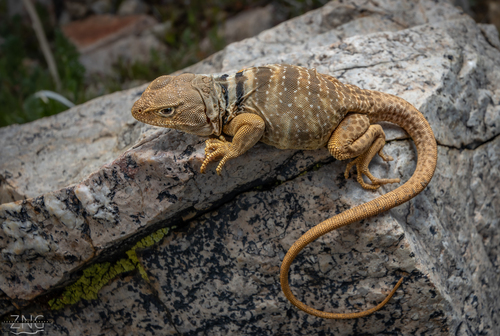
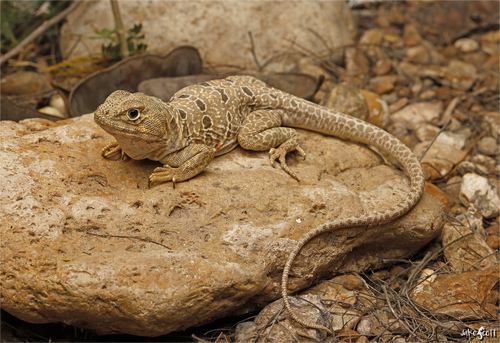
Its base body color can be white, cream, or gray, with irregular brown or dark gray spots along the body and head. Some individuals have dark crossbars across the back, and the tail also bears dark crossbars.
Juvenile Markings
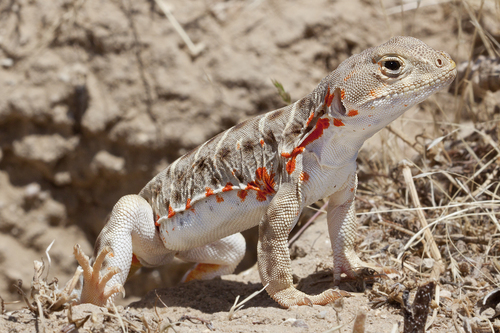
Juveniles have more highly contrasted markings than adults, often with rusty coloring on the back or bright red spots, plus yellow coloring on the thighs and under the tail.
Sexual Size Dimorphism
Males and females differ in appearance: females reach an average snout-vent length of 15 cm (5.8 in), while males are smaller at around 12 cm (4.8 in) snout-vent length.
Color Phase Flexibility
Both sexes can undergo dramatic color changes. In the dark color phase, the lizard's spots are nearly hidden, and light crossbars become very obvious on both the body and tail.
Light Color Phase Pattern
In the light color phase this pattern reverses, with dominant base colors ranging from gray and pinkish to brown or yellowish-brown.
Breeding Season Coloration
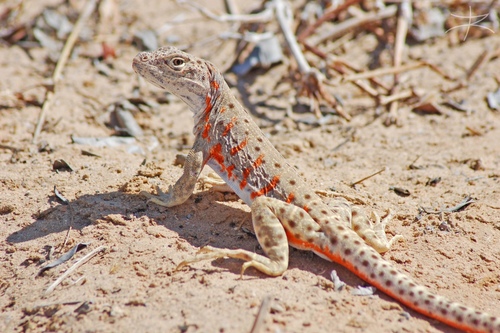
During the mating season, gravid females develop reddish-orange spots and bars on their sides and underneath the tail, while breeding males develop a pink or rusty wash on the throat, chest, and sometimes the body.
Habitat Vegetation Preferences
This species prefers arid and semiarid plains with scattered low plants such as bunch grass, alkali bush, sagebrush, and creosote bush.
Habitat Substrate & Topography
The ground in its habitat can be hardpan, sand, or gravel, often with rocks used as basking sites. G. wislizenii favors flat areas with open space for running, and avoids densely vegetated regions.
Elevation Range
It occurs from near sea level up to around 6,000 feet (1,800 m) in elevation.
Broad Geographic Range
Its range covers the western United States, extending north from Oregon to Idaho, and south into northern Mexico, including Baja California, Sonora, Coahuila, and Zacatecas, as well as Casa Grande, Arizona.
California Local Distribution
In San Diego County, California, it occurs east of the Peninsula Ranges within the Lower Colorado Desert, typically found on desert flats and in lower foothills with sparse vegetation.
Breeding Season Timing
The breeding season for G. wislizenii runs from May to June.
Egg Laying & Hatching Timeline
Most females lay a single clutch of 5 to 6 eggs in June or July, which hatch in late summer, between July and August.
Mating Social Structure
No pair bond forms between mating adults.
Clutch Frequency Variation
Usually only one clutch is laid per year, but females in warmer southern climates may lay up to two clutches per year.
Nesting Behavior
Egg-laying takes place in a burrow, and no structured nest is built.
Egg Incubation Period
The incubation period for eggs is estimated between five and seven weeks.
Juvenile Emergence Timing
Young lizards emerge in August, when adult activity is winding down. This timing of juvenile emergence overlapping with the end of adult activity may help prevent cannibalism.