About Gambelia juncea (Benth.) D.A.Sutton
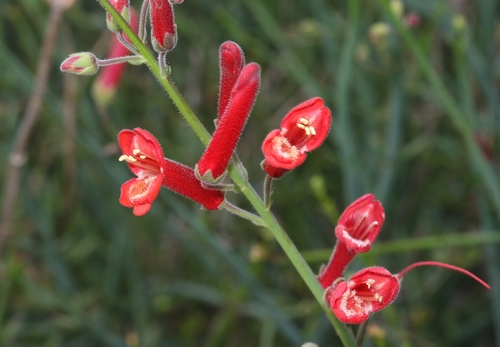
Gambelia juncea is a highly variable woody perennial shrub that reaches up to 1 meter (3.3 feet) tall. Its stems and branches can be reed-like, twisted and clambering; some individuals have small, thin leaves with very little foliage, while others are more leafy with large, wide leaves. Its herbage may be glaucous, covered in glandular hairs, or completely smooth and hairless. It produces showy, long, bright red tubular flowers that have two lips. It can be easily distinguished from the other species in its genus, Gambelia speciosa, by G. speciosa's unique flower structure: the throat of G. speciosa's tubular flower is closed by a projection from the base of its lower lip. Morphologically, Gambelia juncea is an erect or spreading shrub with many slender, highly branched stems that reach 6–15 dm (24–59 in) high. Its nodes are 2–8 cm (0.79–3.15 in) apart, and its internodes are longer than the adjacent leaves. Leaves are arranged oppositely or in whorls of three, and vary in size and pubescence. Leaves range in shape from elliptic to nearly linear, with leaf veins converging toward the leaf tip, and the leaf blade is usually 5 mm (0.20 in) or less in width. Inflorescences are subracemose or axillary, and bear two to three flowers on the upper parts of branches. Pedicels are 1–3 cm (0.39–1.18 in) long. The calyx is bell-shaped and divided into five subequal segments that range from lance-ovate to oblong-ovate. Calyx segments measure 2.5–5 mm (0.098–0.197 in) long when the plant is in flower, growing to 5–7 mm (0.20–0.28 in) when the plant produces fruit. The two-lipped corolla is tubular, 2.5–3 cm (0.98–1.18 in) long, and faintly sac-like at the base. The upper lip is erect and faintly two-lobed, while the lower lip is reflexed and three-lobed. The corolla is bright red. There are four fertile stamens that vary in length: they are often longer than, equal to, or shorter than the corolla, and are sometimes didynamous. The ovary is ovoid and oblique at the base. The fruit is an ovoid capsule that dehisces through a rounded, irregular pore at the apex of each locule. A persistent thread-like style remains attached to the fruit. The seeds are dark, around 1 mm (0.039 in) long, and marked with thin, irregular ridges. Gambelia juncea is native to the Mexican states of Baja California, Baja California Sur, and Sonora. It is widely distributed across the Baja California peninsula, ranging from the area around La Misión in northwestern Baja California south to the Cape region at the southern tip of the peninsula in Baja California Sur. It is only absent from the northeastern part of Baja California and from higher elevations. This species also occurs on various islands in the Gulf of California, is rarely found on the coast of Sonora, and grows on the Pacific coast islands of Cedros, Magdalena, and Santa Margarita. It grows in a wide variety of habitats: from coastal sage scrub and chaparral in the northern part of its range to deserts, mountains, xeric scrublands, and tropical dry forests in the south. It can typically be found growing across a diverse set of microhabitats, including rocky ravines, along desert washes, on hillsides, on cliff faces and narrow ledges, on talus slopes at the base of cliffs, and in coastal areas.