About Gallowayella weberi (S.Y.Kondr. & Kärnefelt) S.Y.Kondr., Fedorenko, S.Stenroos, Kärnefelt, Elix, Hur & A.Thell
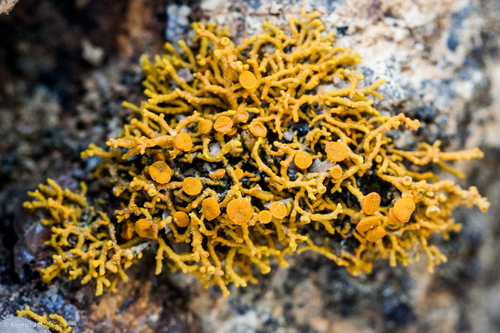
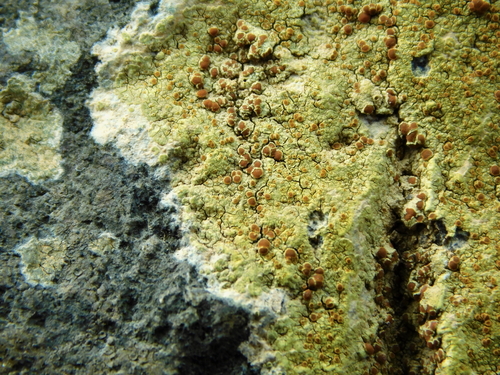
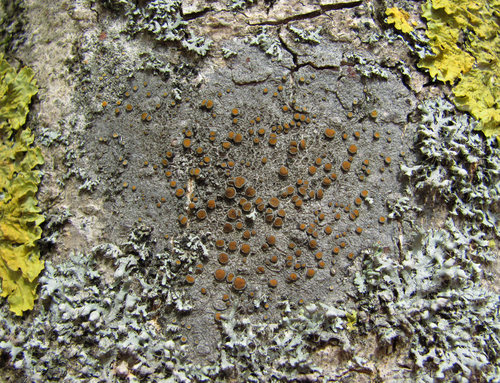
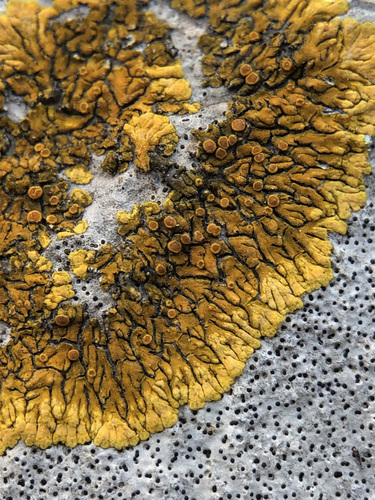
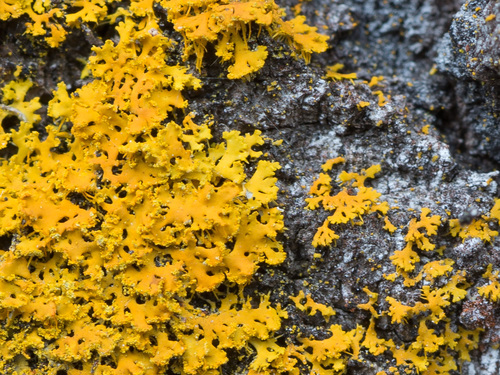
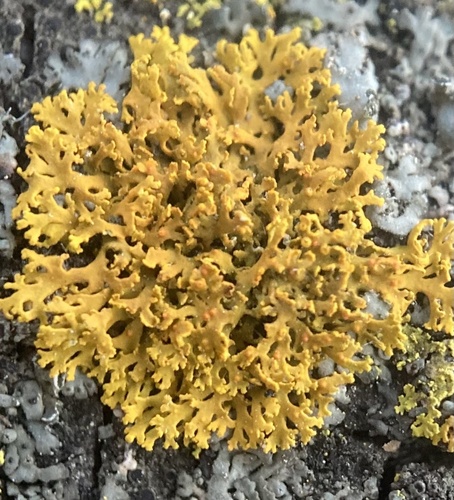
Gallowayella weberi is a foliose lichen that forms small thalli up to 4 mm wide. These thalli adhere to substrates anywhere from closely to somewhat loosely attached. The thallus lobes are flat, range from horizontal to slightly ascending, and measure 0.3 to 0.5 mm wide. Lobe tips often curve inward, and the outermost portions of mature lobes are truncated, or cut off squarely. The upper surface of Gallowayella weberi is yellow to orange and smooth in texture, while the lower surface is distinctly white. The cortex, the lichen's outer layer, is made of tightly packed colorless cells, with the exception of external anthraquinone crystals, a type of chemical compound commonly found in lichens. Its photosynthetic partner (photobiont) is a unicellular green alga belonging to the genus Trebouxia. The medulla, the inner tissue located beneath the cortex, has a net-like structure formed from short cells. Rhizines, root-like structures that anchor the lichen to its substrate, are mostly present, are white in color, and turn yellow when exposed. They may either be attached to the substrate or free. Soralia, the structures responsible for asexual reproduction, develop at lobe tips and often form small structures that resemble bird nests; the powdery reproductive propagules (called soredia) are yellow. Apothecia, the species' fruiting bodies, are rare, and measure 0.7 to 2.0 mm in width. The ascospores of Gallowayella weberi are 12.7 to 14.0 by 7.0 to 7.7 μm, with a septum thickness of 2.9 to 4.6 μm. Pycnidia, another asexual reproductive structure, are common on the laminar (surface) part of the thallus, are orange, and measure roughly 0.1 to 0.2 mm in diameter. The asexual spores (called conidia) are rod-shaped, and measure 3.2 to 3.6 μm in length. In chemical spot testing, the cortex and apothecia turn purple when exposed to potassium hydroxide solution, but show no reaction to other common spot tests (C−, PD−, and I−). The medulla also shows no reaction to these tests. The major secondary lichen metabolites produced by Gallowayella weberi are parietin, fallacinal, and teloschistin, with emodin and parietinic acid occurring as minor components. This specific profile of secondary metabolites matches chemosyndroma A, first proposed by Ulrik Søchting in 1997. Gallowayella weberi can grow on a range of substrates, including natural types like bark and rock, and artificial types like concrete and tombstones. It is native to North America. Herbarium mapping shows it is widespread across the eastern and central United States, with its distribution centered in the coastal plain of the southeastern United States. At the Delaware locality originally used to describe what was then named Xanthomendoza rosmarieae, this lichen grew abundantly on roadside plantings of Norway maple (Acer platanoides).