About Galloperdix lunulata (Valenciennes, 1825)
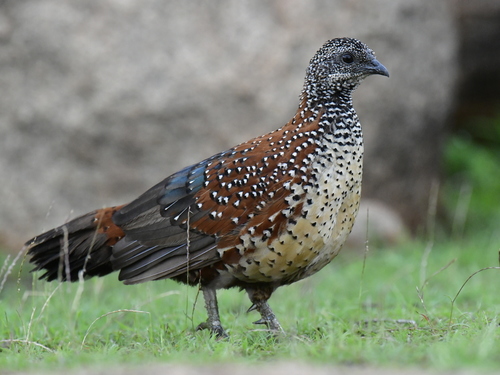
This distinctive species of spurfowl lacks the bare facial skin found on red spurfowl. Males have a black tail and ochre underparts that contrast with their darker upperparts. Upperpart plumage and feathers have white spots edged with black. A male’s head and neck are black with a green sheen and fine white spotting, while its mantle, rump, and wing coverts are chestnut. Females are much duller in color, with a rufous brow and rufous ear coverts. Females have a pale throat patterned with spots matching the male’s, but lack white spotting on their bodies. Both sexes have dark grey bills and legs. Males have two to four tarsal spurs, while females may have one or two spurs. Individuals sometimes carry their tails upright. Painted spurfowl are distributed across parts of the Aravalli ranges in Rajasthan, the hills of central India including Pachmarhi, the Nallamala region of Andhra Pradesh’s Eastern Ghats, and rocky hills and dry forest areas of southern India. Their habitat is drier than that of the red spurfowl. In parts of southern India, they occupy rocky hills with scrub slopes, a habitat also shared with the yellow-throated bulbul. Painted spurfowl occur in pairs or small family parties of up to 6 individuals. They tend to remain in undergrowth and rarely fly. Their call is a loud, repeated series of chuguk notes. They feed on berries including those of Ziziphus oenoplia and Lantana camara, insects, and flowers of Madhuca longifolia, and visit waterholes in the early morning. Their breeding season runs from January to June, with most breeding occurring in February, though chicks have been observed in August after the rains in parts of Rajasthan. During courtship, the male offers food held in his bill to the female. The genus Galloperdix is generally considered to be monogamous. The nest is a ground scrape lined with leaves, usually placed under a boulder. Clutches contain three to four eggs, rarely five, and are pale creamy in color. Only the female incubates the eggs, but both parents care for the chicks. Both parents use distraction displays to lead predators away from the chicks.