About Gallinula mortierii (Du Bus de Gisignies, 1840)
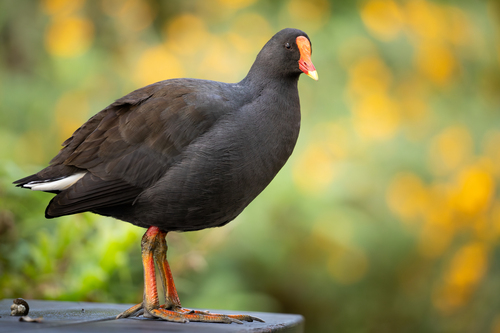
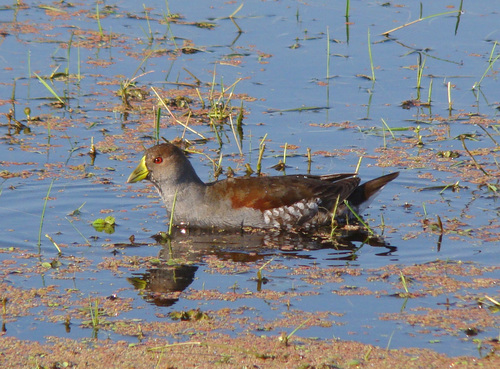
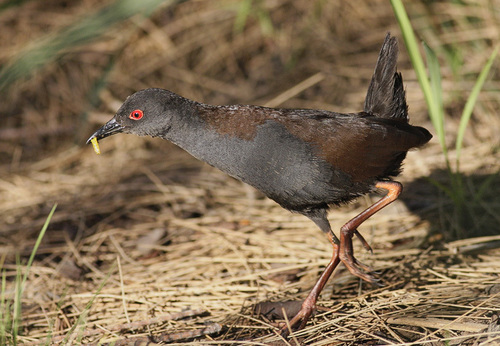
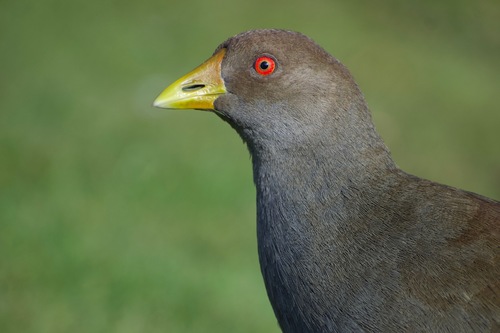
The Tasmanian nativehen (scientific name: Gallinula mortierii (Du Bus de Gisignies, 1840)) is a stocky, flightless bird that measures 43 to 51 centimetres (17 to 20 inches) in length. Its upperparts are olive-brown, with a white patch on the flank, while its underparts are darker with a bluish-grey tinge. It has a short, near-black tail that is mostly held erect, thick, powerful grey-scaly legs with sharp claws, bright red eyes, and a greenish-yellow bill with a small frontal shield. Juvenile birds look similar to adults, but have more subdued body coloration, fine white spots on the underparts, a greenish-yellow bill, and bright red eyes. Males typically have longer bills and legs than females, but the overlap in measurement between the sexes means they cannot be distinguished even when handled.
For distribution and habitat: this species is endemic to Tasmania, where it is widespread across most of the island, excluding the western and south-western regions. It is a sedentary species that lives near open grassy areas adjacent to water. It is not found on King Island or Flinders Island in the Bass Strait, though Michael Sharland has recorded it as present on Flinders Island. A population introduced to Maria Island is now well established. It is generally common and easily spotted near bodies of water with grassy verges. Fossil records show that it lived on the Australian mainland until approximately 4,700 years ago. Proposed causes for its extirpation from the mainland include human overhunting, the introduction of the dingo, and an extremely dry period.