About Gallinula melanops (Vieillot, 1819)
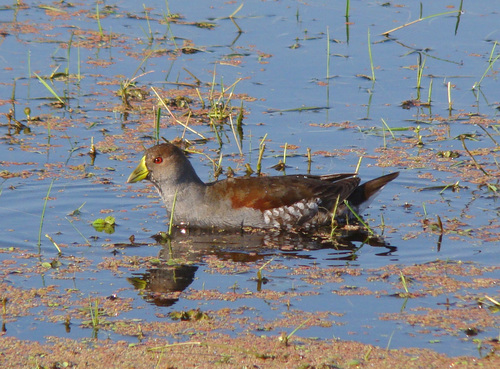
Spot-flanked gallinule, with the scientific name Gallinula melanops (Vieillot, 1819), is a small waterfowl-like bird. It weighs between 154 and 225 grams, and has an average length of 28 cm. Its head, chin, neck and breast feathers are slate gray, which contrasts with the black forehead and crown that extends to the top of the nape. Its covert feathers are a brown, cocoa-like color, while primary feathers have a slight color contrast and are a darker shade of brown. As the common name suggests, this species has brown flanks marked with white mottling, and its rump is a mix of the same brown and white shades. Juveniles lack contrasting plumage, and are typically entirely black before developing brown feathers and later gaining the other distinctive features of mature individuals. Most noticeably, this species is called Green-Billed Tingua in Spanish because of its pale green beak. Juveniles have black and pink beaks, which become pale green as the bird ages. Its legs are a drab green-gray color, and are rarely visible because the bird spends most of its time in the water. The iris changes color with age: it is black in juveniles, then shifts to different shades of brown, and finally becomes a vibrant red when the bird reaches maturity. This species prefers habitats in both natural and artificial zones, and shows a strong preference for ornamental lakes, artificial ponds, and natural wetlands. It can also be found in microhabitats with emergent vegetation, or in grassy parks. Spot-flanked gallinules are distributed generally across South America, with larger populations located in Brazil, Argentina, Chile, Paraguay and Uruguay. The distinct subspecies P. m. bogotensis is found in Colombia, isolated from other breeding populations of Gallinula melanops. For reproduction, both males and females participate in nest construction and chick care, and only one breeding pair occupies each body of water. Nests are usually built from branches, fresh and dried leaves, and occasionally feathers. They are placed close to the water's edge, or sometimes above water, and are sheltered and hidden by dense surrounding vegetation. On average, nests hold between three and six oval-shaped eggs. The eggs are cream-colored, with dark brown mottling concentrated toward their bottom end. Both parents incubate the eggs in shifts, and the relieving parent often uses a cackling-like call to signal it is time to switch incubation duties. Parents maintain this routine for the full 18–20 day incubation period. After hatching, developed chicks are fed and protected by their parents for 50 days. Chicks have full swimming and diving capabilities within just a few hours of hatching.