About Gallacea scleroderma (Cooke) Lloyd
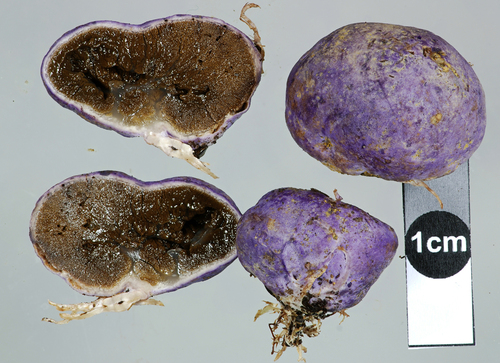
Gallacea scleroderma produces hypogeous (underground) fruiting bodies that range from roughly spherical to irregular in shape, and typically measure 2–5 cm (0.79–1.97 in) in diameter. Its outer surface, called the peridium, is firm, thick, and may have a velvety texture, which gives the species its common name "velvet potato fungus." When cut open, the gleba is brown to muddy brown in color. Its spores are ellipsoid, smooth, brown, and measure approximately 10 by 5 micrometres (μm). This fungus is endemic to New Zealand. It is primarily found in Nothofagus forests, and forms ectomycorrhizal associations with a range of southern beech trees, including N. fusca, N. menziesii, N. solandri, and N. cliffortioides. These associations have been recorded in multiple herbarium specimens across New Zealand. A 2025 analysis of fossilized moa droppings confirmed that moa consumed Gallacea scleroderma, and were likely a major disperser of this fungus.

