About Galium obtusum Bigelow
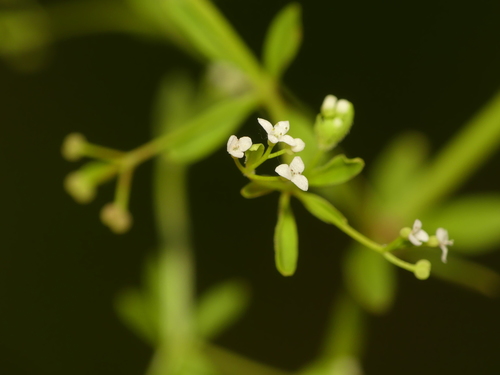
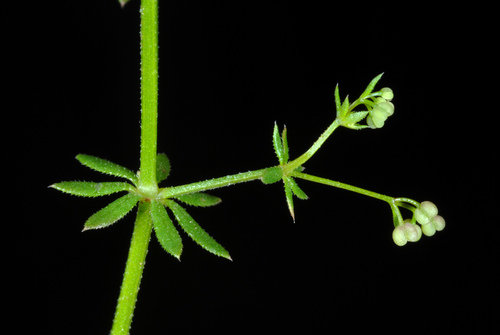
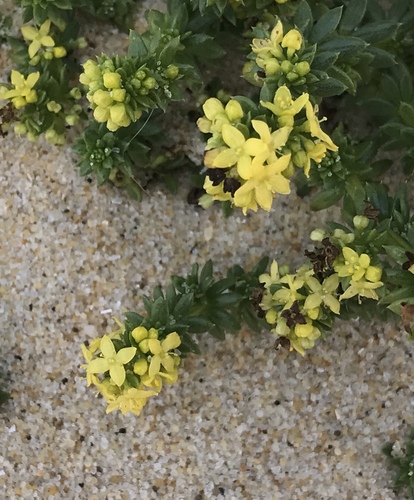
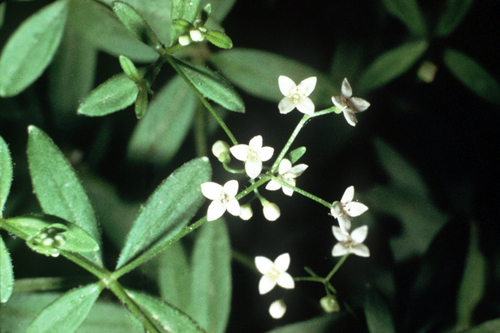
Galium obtusum Bigelow has white petals and green sepals. Each flower has four petals that fuse with the sepals, forming an overall cup shape. The flower also has four stamens with black tips, two styles, and exhibits radial symmetry. The ovary is epigenous, and the inflorescence is a dichasium. It has an adventitious root structure. Its fruit is indehiscent, meaning it does not open when mature. The fruit has a smooth outer surface, is very small, averaging 0.4–0.5mm in length, and most commonly holds one seed per fruit, though two seeds in a single fruit occur rarely. Its leaves are simple with entire margins, are mostly glabrous with very few hairs, and grow in a whorled arrangement with an average of four to five leaves per whorl. Leaves in each whorl are the same size or very close in size. In North America, Galium obtusum is found across most eastern states, but it is eradicated from Maine. It is very rare in Vermont, New Hampshire, and Florida. It is considered a noxious weed in New York, Massachusetts, Rhode Island, Connecticut, and Pennsylvania, where it competes with agricultural crops. It does not grow anywhere in western North America. It can grow in both full sun and partial sun, in a range of habitats including deciduous forests, wetlands, meadows, areas growing among trees and shrubs, riverbanks, and shorelines. A 16-year study of Kalsow Prairie, Iowa found that Galium obtusum has a positive intraspecific association with a wide variety of other species, suggesting it plays an ecological role alongside other plants in its habitat. The same study recorded a 5% increase in the species' frequency over the study period. In other parts of North America, Galium obtusum can reduce the yield of agricultural crops. The genus name Galium comes from the Greek word meaning "milk", which suggests this species may have been used to curdle milk. Some people grow Galium obtusum as a decorative plant, but it is not popular as an ornamental.