About Galium circaezans Michx.
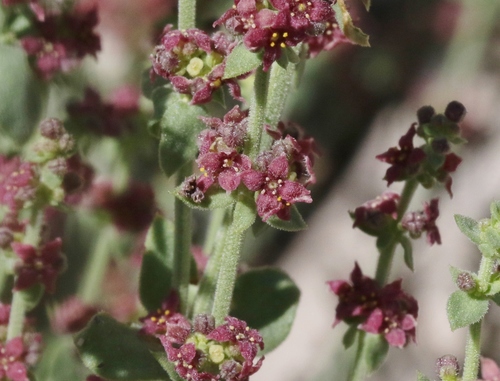
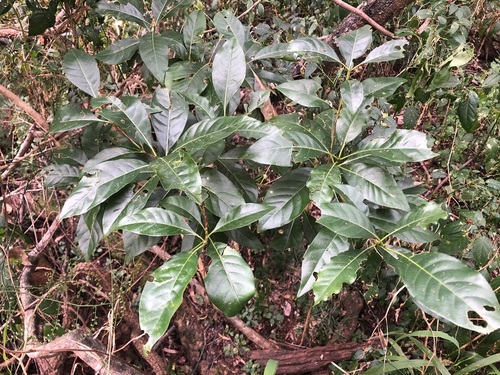
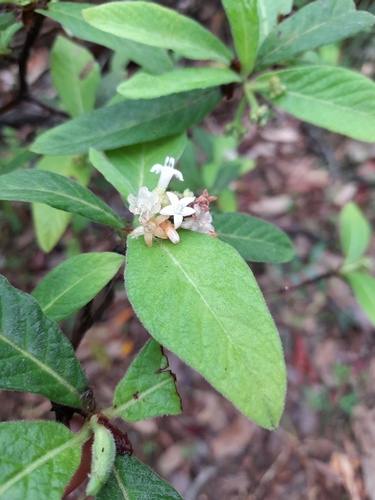
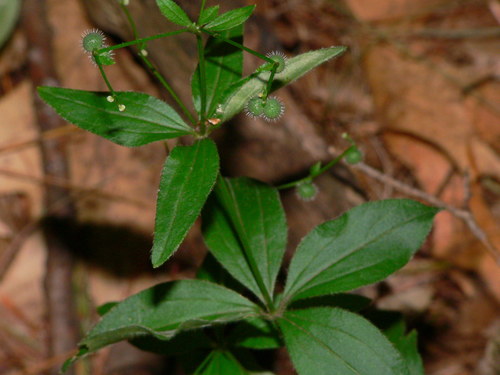
Galium circaezans Michx. grows to a height of about 1 to 2 feet, with an equal spread of 1 to 2 feet. It blooms from May to July, producing tiny sessile flowers arranged along the branches of each inflorescence. Each flower is roughly 1/8 of an inch across, radially symmetrical, with 3 to 4 greenish lobes. Individual flowers have a pair of styles, a double-ovoid ovary, a 4-lobed greenish-white to greenish yellow corolla, and 4 stamens. When mature, the ovary develops into a dry, spherical, indehiscent, reflexed, one-seeded fruit, which measures about 3 mm long and is dark brown or black. The fruit surface is covered in hooked bristles that help with seed dispersal, and it remains dry and does not split open when ripe. This species has pubescent, lanceolate to ovate medium green leaves that grow in whorls of four; leaves are sessile, about 2.5 inches long, sparsely pubescent, have three prominent parallel veins, and have entire margins. Stems are light green and square in cross-section. Galium circaezans is most closely related to other Galium species that mostly produce leaves in whorls of 4 at primary nodes, or rarely 5 or 6 in some related species. Galium circaezans occurs in the contiguous lower 48 United States, as well as parts of Canada and Alaska. It is found throughout the Southeastern United States, ranging west as far as Texas, Oklahoma, and Nebraska, and north into the Canadian provinces of Quebec and Ontario. Its primary habitat is mesic to dry forests, and it has been recorded in rich loamy ravines, rich moist or dry woods, and dry wooded bluffs. It prefers partial shade, requires dry to moderate amounts of water, has medium maintenance requirements, and tolerates drought and dry soil. Its wetland status is FACU in the Arid West, Atlantic and Gulf Coastal Plain, Great Plains, Midwest, Northcentral & Northeast, and Western Mountains, Valleys, and Coast regions; it is classified as UPL in the Eastern Mountains and Piedmont region.