About Galium aparine L.
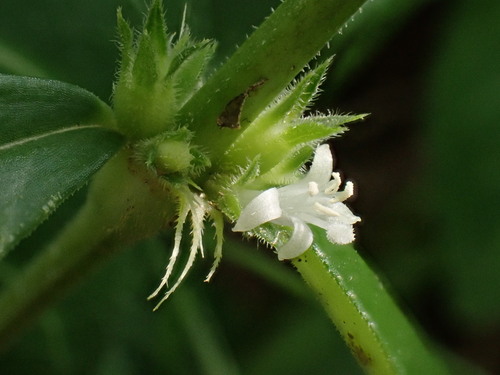
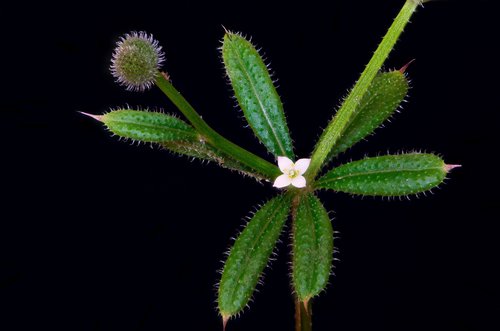
Galium aparine L., commonly known as cleavers or goosegrass, is an annual plant with branching creeping, straggling stems that grow along the ground and over other plants. Small hooked hairs protruding from its stems and leaves allow the plant to cling to surfaces. Stems can reach up to 1.2 metres (4 feet) tall, and have an angular or square shape. Its leaves are simple, ranging from narrowly oblanceolate to linear in shape, and grow in whorls of six to eight. Cleavers produce tiny, star-shaped flowers that are white to greenish, which bloom from early spring through summer. These flowers grow in clusters of two or three, emerging from leaf axils, and the corolla has four petals. The plant’s globular fruits are burrs that hold clusters of one to three seeds, and are covered in hooked hairs that cling to animal fur and human clothing to aid seed dispersal. This species is native to a wide region covering Europe, North Africa, and Asia, ranging from Britain and the Canary Islands to Japan. It is currently naturalized across most of the United States, Canada, Mexico, Central America, South America, Australia, New Zealand, some oceanic islands, and scattered locations in Africa. While there is some debate over whether it is native to North America, most sources consider it native to the continent. It is classified as a noxious weed in many areas. In terms of ecology, cleavers grows in hedges, waste places, limestone scree, and as a weed in gardens. It prefers moist soils and can survive in areas with poor drainage. It is reported to thrive in heavy soils with above-average nitrogen and phosphorus content, and favors soils with a pH between 5.5 and 8.0. In the United States, it is often found in post-fire plant communities, likely growing from existing on-site seed. This makes controlled burns an ineffective method for removing G. aparine in areas where it is considered a noxious weed. Geese frequently eat this plant, which gives it the common name goosegrass. Many insects including aphids and spittlebugs feed on cleavers. The compound nordamnacanthal (1,3-dihydroxy-anthraquinone-2-al), an anthraquinone aldehyde found in G. aparine, has antifeedant activity against Spodoptera litura, the Oriental leafworm moth, an agricultural pest species. The mite Cecidophyes rouhollahi can also be found growing on G. aparine. For some people, contact with cleavers can cause skin irritation. Even though the plant’s hairs are very small, they can scratch more sensitive areas of the skin, and numerous scratches can appear similar to a rash. In traditional folk medicine, poultices and washes made from cleavers were historically used to treat a range of skin ailments, light wounds, and burns. As a pulp, it was used to relieve irritation from venomous bites and stings. To make a poultice, the entire plant is used and applied directly to the affected area. The most common preparation is a tea brewed from dried leaves, which can be brewed either hot or cold. For a cold infusion, the leaves are steeped in water and refrigerated for 24 to 48 hours. Historically, Dioscorides recorded that ancient Greek shepherds used cleavers’ barbed stems to make a rough sieve for straining milk. Carl Linnaeus later documented the same use in Sweden, and this tradition is still practiced today. In Europe, dried matted cleavers foliage was once used as stuffing for mattresses. Multiple bedstraw species were used for this purpose, because the plant’s clinging hairs cause branches to stick together, helping the mattress filling retain a uniform thickness. Cleavers roots can be used to produce a permanent red dye. Historically, children in Britain and Ireland have used cleavers for entertainment: the tendency of its leaves and stems to stick to clothing is used in various play activities, such as mock camouflage and pranks.