About Galictis vittata (Schreber, 1776)
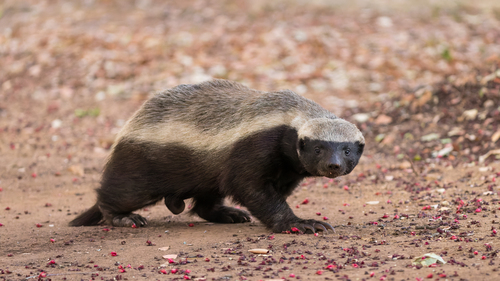
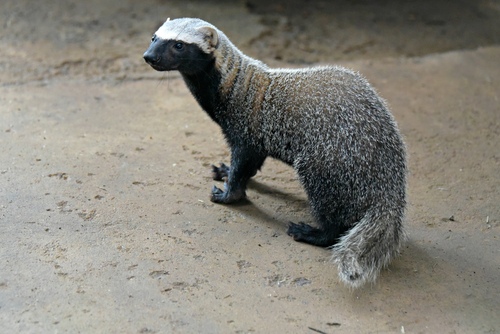
The greater grison (Galictis vittata) is a slender animal with short legs, a long neck, and a short, bushy tail. It closely resembles its close relative, the lesser grison, and is most easily distinguished by its larger size. Its head-body length ranges from 45 to 60 cm (18 to 24 in), and wild adults weigh between 1.5 and 3.8 kg (3.3 and 8.4 lb); captive individuals may grow larger than their wild counterparts. The back, flanks, top of the head, and tail are grizzled grey, while the rest of the body is much darker, usually solid black. A narrow whitish stripe separates the darker and lighter fur on the head and shoulder; this stripe does not extend further back, and the two fur colors may blur together in some individuals further along the body. The tail is 14 to 20 cm (5.5 to 7.9 in) long, and is covered in bushy fur that matches the color of the animal's back. The head is flattened and broad, with short, rounded ears, and dark brown to black eyes. The legs are muscular, and each foot has five webbed toes ending in a sharp, curved claw. Greater grisons are native to North and South America, with a range that extends from southern Mexico in the north to central Brazil, Peru, and Bolivia in the south. They live in a wide variety of forest and cerrado habitats, and are most commonly found near rivers and streams. They typically occur at elevations below 500 m (1,600 ft), but can be found as high as 2,000 m (6,600 ft) in some areas of the Bolivian Andes. In some regions, they may also inhabit cultivated areas including plantations and rice paddies. Four living and one fossil subspecies are currently recognized: G. v. vittata found in northern South America, G. v. andina found in Peru and Bolivia, G. v. brasiliensis found in Brazil, G. v. canaster found in Central America and southern Mexico, and † G. v. fossilis, a Pleistocene subspecies from Brazil.