About Galerina vittiformis (Fr.) Singer
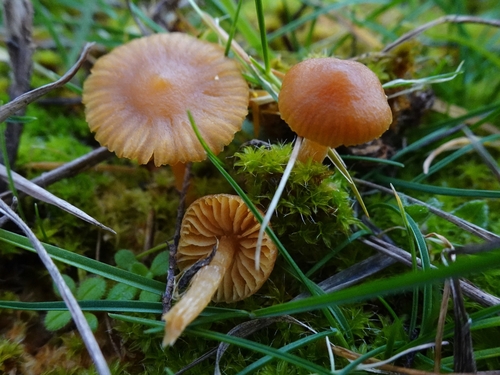
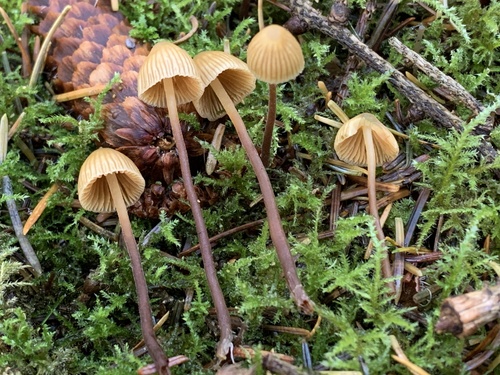
Galerina vittiformis (Fr.) Singer has a honey-colored, striped, hygrophanous cap that grows up to 1 centimeter (1/2 inch) wide. When young, the cap is bluntly conical; it becomes broadly convex with age, and may even flatten out, often retaining a prominent umbo. Its gills are adnate, and range in color from tawny to cream. The species produces a reddish-brown spore print. The stem can reach up to 5 cm (2 in) long and 2 mm (1/16 in) thick, is equal in width along its length, and ranges in color from pale yellow to chestnut brown. When young, the stem has a slight downy texture, and it has no veil. The flesh is thin and fragile. Microscopically, the spores are egg-shaped, measuring 10–12.3 x 5–6.5 μm. The spore plage is sharply defined, and spores have an apical callus. Each basidium holds 2 spores, measures 20–24 x 7–8 μm, and is colorless in KOH. Pleurocystidia and cheilocystidia range from abundant to scattered, measure 56–74 x 10–16 μm, are thin, fusoid-ventricose with an acute or rounded tip, and are also colorless in KOH. This species is widely distributed in temperate regions, where it typically grows in moist locations, often among mosses. It has been shown to bioaccumulate various heavy metals from contaminated soil. In North America, it can generally be found from June to September, and can appear somewhat later on the West Coast, where it is more common.