About Galerina marginata (Batsch) Kühner
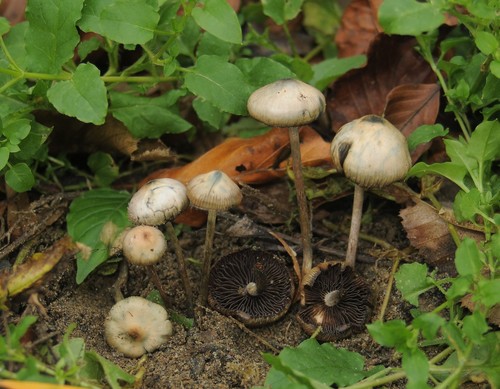
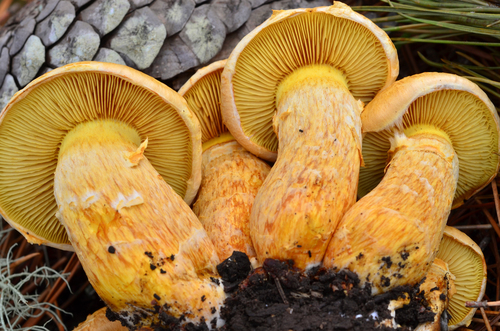
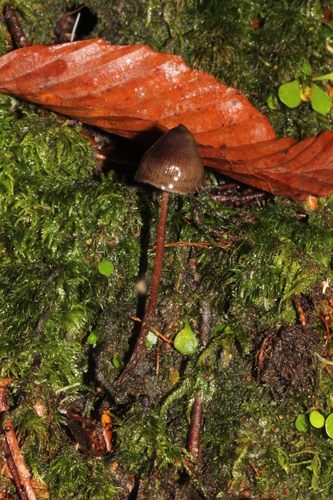
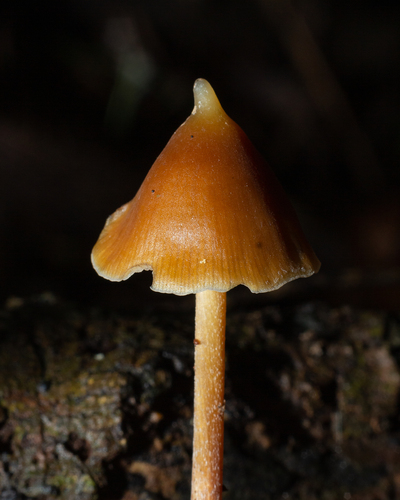
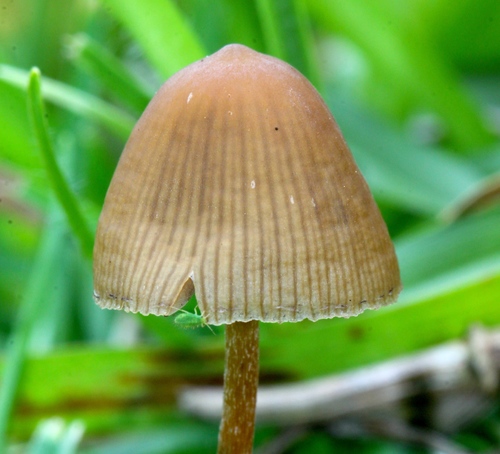
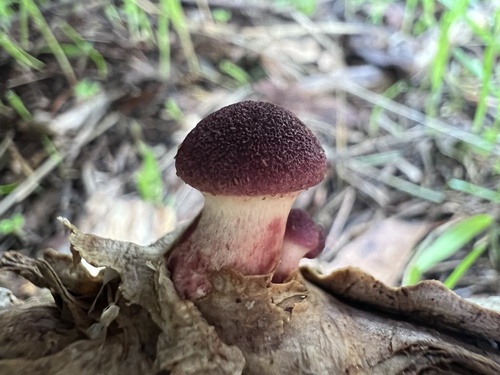
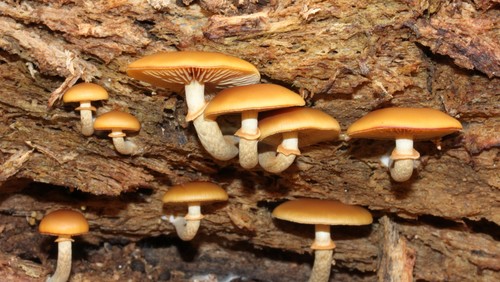
This species has the scientific name Galerina marginata (Batsch) Kühner. The cap of Galerina marginata ranges from 1 to 6 centimetres (1⁄2 to 2+1⁄4 in) in diameter. Young caps are convex, sometimes broadly conical, with margins that curve inward toward the gills. As the cap matures and expands, it becomes broadly convex and then flattened, and sometimes develops a prominent raised central area called an umbo. Because G. marginata currently includes five previously separate taxa, cap surface texture varies significantly. Descriptions recorded by Smith and Singer cover a range of textures: "viscid" for what was formerly called G. autumnalis, "shining and viscid to lubricous when moist" for former G. oregonensis, a range from "shining, lubricous to subviscid (dirt particles adhere to the surface) or merely moist, with a fatty appearance although not distinctly viscid" for some forms, and "moist but not viscid" for the original G. marginata. The cap surface is always smooth, and it changes color based on humidity (a trait called hygrophanous): when young and moist, it is pale to dark ochraceous tawny over the central cap disc and yellow-ochraceous on the margin, fading to dull tan or darker when dry. When moist, the cap is somewhat translucent, so the gills' outlines are visible as faint striations. The cap flesh is pale brownish ochraceous to nearly white, thin and pliant, with an odor and taste that ranges from very faintly to strongly farinaceous, meaning it smells and tastes like flour. The gills are typically narrow and crowded closely together, attaching to the stem in a form ranging from broadly adnate to nearly decurrent, and have convex edges. They are pallid brown when young, turning tawny brown at maturity. Short gills called lamellulae, which do not reach all the way from the cap edge to the stem, are spaced between the full-length gills. The stem measures 2 to 8 cm (3⁄4 to 3+1⁄8 in) long, 3–9 mm thick at its top, and stays the same width along its length or widens slightly toward the base. It starts solid when young, becoming hollow from the base upward as it matures. A thin membranous ring sits on the upper half of the stem near the cap, but it may break off and disappear in older specimens. The ring is initially whitish or light brown, but usually darkens to rusty brown in mature specimens after spores drop onto it. Above the ring, the stem surface has a very fine whitish powder and is paler than the cap; below the ring it is brown down to a reddish-brown to bistre base. The lower stem has a thin coating of pale fibrils that eventually disappear, leaving no scales behind. The spore print of G. marginata is rusty-brown. In terms of microscopic characteristics, the spores measure 8–10 by 5–6 μm. They are slightly inequilateral in profile view, and egg-shaped when viewed from the front. Like all Galerina species, the spores have a plage, which has been described as resembling "a slightly wrinkled plastic shrink-wrap covering over the distal end of the spore". The spore surface is warty and wrinkled, with a smooth depression where it was once attached to the spore-bearing basidium via the sterigmatum. When placed in potassium hydroxide (KOH) solution, the spores appear tawny or darker rusty-brown, and have an apical callus. The basidia are almost always four-spored, with rare exceptions holding a small number of two spores. When producing spores they are roughly cylindrical, with a slightly tapered base, and measure 21–29 by 5–8.4 μm. Cystidia are sterile, non-spore-producing cells in the fertile hymenium that are structurally distinct from basidia, and grouped by their location on the gill. In G. marginata, pleurocystidia (cystidia growing on the gill sides) measure 46–60 by 9–12 μm, are thin-walled and hyaline (transparent) in KOH, and shaped fusoid to ventricose, with wavy necks and blunt to nearly pointed apices that measure 3–6 μm in diameter near the tip. Cheilocystidia (cystidia on the gill edges) have a similar shape but are often smaller than pleurocystidia, are abundant, and no club-shaped or abruptly tapering mucronate cells are present. Clamp connections are present in the fungal hyphae. Galerina marginata is a saprobic fungus, meaning it gets nutrients by breaking down organic matter. It produces most major classes of secreted enzymes that break down plant cell wall polysaccharides, and it has been used as a model saprobe in recent studies of ectomycorrhizal fungi. Because it has a range of enzymes capable of breaking down wood and other lignocellulosic materials, the Department of Energy Joint Genome Institute (JGI) is currently sequencing its genome. The fungus usually grows on or near conifer wood, though it has also been observed growing on hardwood. Fruit bodies may grow alone, but more typically grow in groups or small clusters, and appear from summer to autumn. Sometimes they grow on buried wood, so they may appear to be growing directly from soil. Galerina marginata is widely distributed across the Northern Hemisphere, found in North America, Europe, Japan, Iran, continental Asia, and the Caucasus. In North America, it has been collected as far north as Canada's boreal forest and subarctic and arctic habitats in Labrador, and as far south as Jalisco, Mexico. It is also found in Australia and Antarctica. Galerina marginata contains toxic compounds called amatoxins. Amatoxins are a family of bicyclic octapeptide derivatives made of an amino acid ring bridged by a sulfur atom, distinguished by different side groups. These compounds are responsible for more than 90% of fatal human mushroom poisonings. Amatoxins work by inhibiting the enzyme RNA polymerase II, which copies genetic code from DNA into messenger RNA. The toxin naturally accumulates in liver cells, and the resulting disruption of metabolism causes severe liver dysfunction. Amatoxins also lead to kidney failure: when the kidneys attempt to filter out the toxin, it damages the kidney's convoluted tubules, then reenters the bloodstream to recirculate and cause additional damage. Initial symptoms after ingestion include severe abdominal pain, vomiting, and diarrhea, which last for six to nine hours. After this initial phase, the toxins severely damage the liver, leading to gastrointestinal bleeding, coma, kidney failure, or death, usually within seven days of consumption. Multiple studies have shown that G. marginata contains the amatoxins α-amanitin and γ-amanitin; this was first documented when the fungus was still classified as G. venenata, and later confirmed for G. marginata and G. autumnalis. The species' ability to produce these toxins was confirmed by growing mycelium in liquid culture, where only trace amounts of β-amanitin were found. G. marginata is thought to be the only species in amatoxin-producing genera that can produce these toxins when grown in culture. Both α-amanitin and γ-amanitin have been quantified in samples of what was then classified as G. autumnalis at 1.5 mg/g dry weight, and in G. marginata at 1.1 mg/g dry weight. Later experiments confirmed the presence of γ-amanitin and β-amanitin in German specimens of G. autumnalis and G. marginata, and found all three amanitins in the fruit bodies of G. unicolor. Some older mushroom field guides claim the species, listed as G. autumnalis, also contains phallotoxins (though phallotoxins cannot be absorbed by humans), but scientific evidence does not support this claim. A 2004 study found that the amatoxin content of G. marginata varied from 78.17 to 243.61 μg per gram of fresh weight. In this study, some G. marginata specimens had higher amanitin amounts than some specimens of Amanita phalloides, a European fungus widely considered to have the highest amanitin content. The study authors note that "other parameters such as extrinsic factors (environmental conditions) and intrinsic factors (genetic properties) could contribute to the significant variance in amatoxin contents from different specimens." The lethal dose of amatoxins for humans has been estimated to be about 0.1 mg per kg of body weight, or even lower. Based on this estimate, eating 10 G. marginata fruit bodies with around 250 μg of amanitins per gram of fresh tissue could poison a 20 kilogram (44 lb) child. However, a 20-year retrospective study of more than 2100 amatoxin poisoning cases from North America and Europe found that only a small share of cases were caused by eating Galerina species. This low frequency may be because G. marginata is a nondescript "little brown mushroom" that is often overlooked by foragers, and because 21% of amatoxin poisonings come from unidentified species. The toxicity of some Galerina species has been known for over a century. In 1912, Charles Horton Peck reported a human poisoning case caused by G. autumnalis. In 1954, a poisoning case was caused by G. venenata. Between 1978 and 1995, ten poisoning cases caused by amatoxin-containing Galerinas were reported in scientific literature. Three European cases, two from Finland and one from France, were attributed to G. marginata and G. unicolor respectively. Seven North American exposures included two fatal cases from Washington caused by G. venenata, and five cases that responded successfully to treatment. Four poisonings were caused by G. autumnalis collected in Michigan and Kansas, with one additional poisoning caused by an unidentified Galerina species from Ohio. Many poisoning cases occur when collectors misidentify G. marginata as the hallucinogenic mushroom Psilocybe stuntzii.