About Galeopsis pubescens Besser
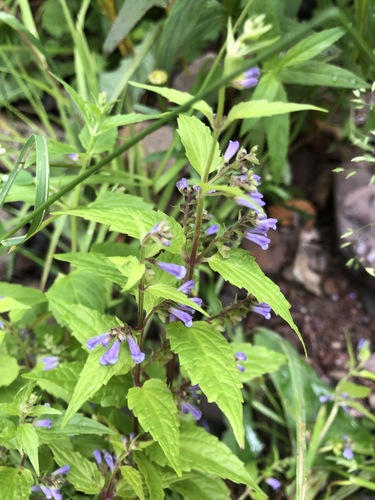
Galeopsis pubescens Besser, commonly called hairy hempnettle, is an upright-growing herbaceous annual plant. It typically reaches 20 to 50 centimetres in height, and usually has a spreading upper section. Its four-edged stem is covered with a mix of soft and bristle-like hairs; bristles are concentrated mostly on the plant’s nodes, and the stem is almost always thickened just below the nodes.
Its leaves are alternately arranged, simple, entire, and always petiolate (attached with leafstalks). They are serrated, covered in trichomes, grow up to 7 centimetres long, shaped lanceolate to ovate-lanceolate, and end in a sharp point. This species has no stipules.
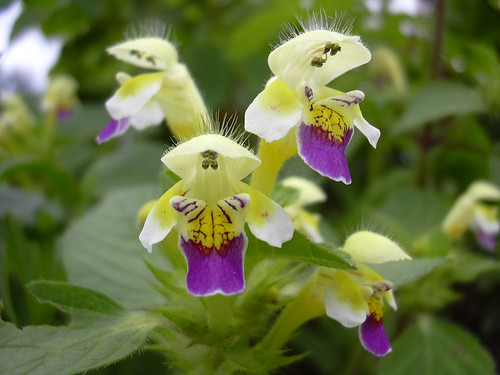
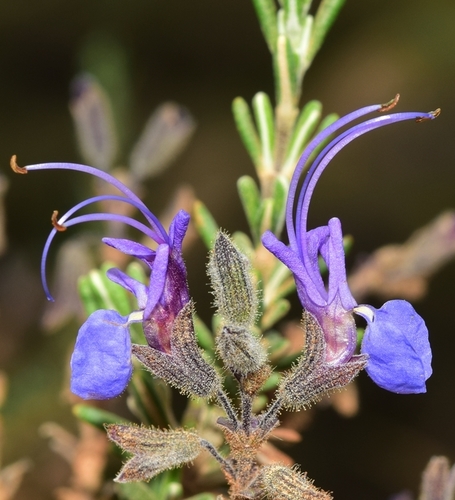
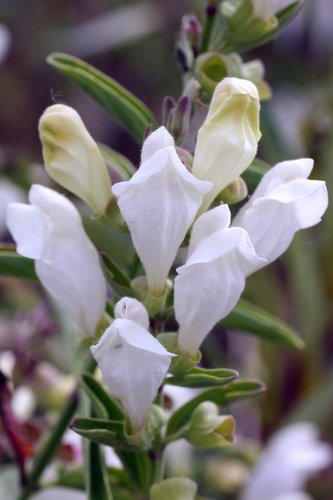
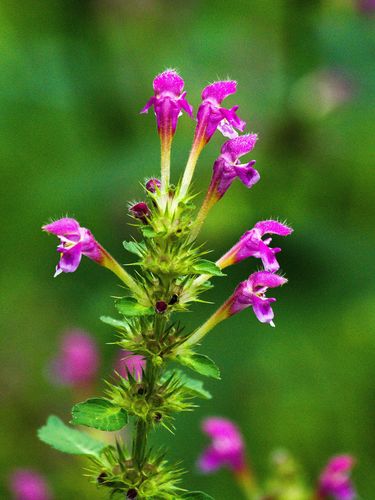
Its flowers are scarlet to scarlet-red, zygomorphic, and measure 2 to 2.5 centimetres across. They are arranged in a seemingly whorled inflorescence that is actually a cyme. Like other members of the sage (Lamiaceae) family, Galeopsis pubescens has two-lipped, bilabiate flowers. Its fused petals form a yellow corolla tube. The upper lip is three-lobed, with a larger central lobe marked with a white or yellow spot, and smaller side lobes. The scarlet lower lip is bent and covered in coarse hairs. The plant’s sepals are fused into a calyx tube, covered in a thick layer of hair, and end in pointed calyx teeth. Flowers do not contain essential oils, so they have no distinct scent.
This is an entomophilous (pollinated by insects) species that flowers between July and September. Its dry fruits are brown to black nutlets, produced in groups of four with one seed per nutlet. Lay people often confuse Galeopsis pubescens with other similar hempnettles, including Galeopsis tetrahit and Galeopsis bifida, as well as other Lamiaceae species like Lamium maculatum. This species has a history of use in traditional medicine.
Galeopsis pubescens is widely distributed across Europe, with its range extending from eastern France in the west to Russia, the Caucasus, and Siberia in the east. It occurs as an introduced species in some parts of Asia. It is a relatively common plant that grows in many different habitats, including human-made sites. It is most often found in forests, along forest edges, near paths, in fields, in vineyards, and in various ruderal landscapes. Its optimal habitats are different forest types: alluvial, oak-hornbeam, ravine, herb-rich beech, acidophilous thermophilous oak, black locust (Robinia pseudoacacia), and spruce forests. The Raunkiær system classifies it as a therophyte, as it is an annual plant that survives unfavorable conditions as seed.