About Galearis spectabilis (L.) Raf.
Scientific name: Galearis spectabilis (L.) Raf.
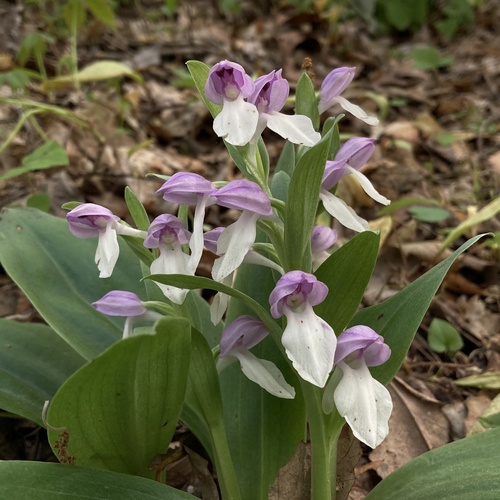
Galearis spectabilis grows in mesic deciduous woodlands of the eastern United States. It produces one or two oval, fleshy basal leaves from a rhizome, and these leaves persist throughout the entire summer. Flower stalks grow 10–15 centimeters (3.9–5.9 inches) tall, and bear three to twelve flowers that bloom from April to May. The flowers are showy, typically bicolored lavender and white, and form a distinct hood that gives the plant its common name. The lavender hood is made from three fused sepals; two petals are tucked inside the hood, while the longer third petal, called the labellum, is white. Two formal color variants exist: G. spectabilis f. gordinierii produces all-white flowers, while G. spectabilis f. willeyi has entirely pink flowers.
This species begins new growth each spring. It is most often found on rocky, damp hillsides near seeps, growing under a deciduous tree canopy in half to deep shade. It has also been reported growing successfully near floodplains, always under a deciduous canopy, and is rarely found growing in full sun. It is slow-growing, and forms clumps over time through crown offshoots produced from its rhizome. Pollination of G. spectabilis is carried out by long-tongued Bombus bees, as well as other bees, butterflies, and moths. In addition to attracting pollinators with its distinct coloration, its flowers produce nectar that collects at the base of the flower spur as a reward for visiting pollinators.