About Galearis rotundifolia (Banks ex Pursh) R.M.Bateman
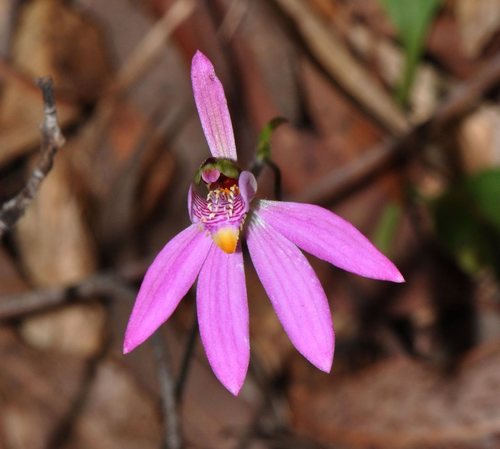
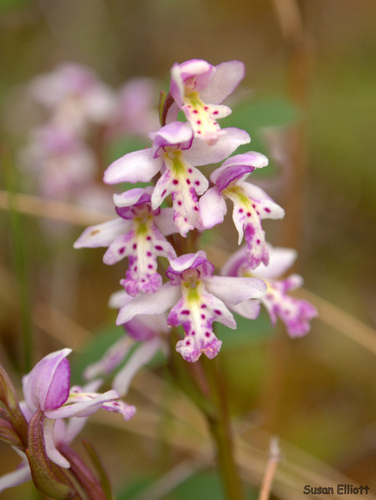
Galearis rotundifolia (Banks ex Pursh) R.M.Bateman is a succulent perennial herb that grows from a fleshy rhizome. It reaches a maximum height of around 33 centimeters. A single leaf clasps the base of the stem; this leaf varies in shape and size, and can grow up to 11 centimeters long. The inflorescence is a spike of flowers with leaflike bracts that sits at the top of the stem. An individual plant can produce up to 18 flowers at one time. Each flower has six tepals in shades of white or light magenta: three are sepals up to one centimeter long, and three are shorter, narrower petals. The spurred, lobed lip of the middle petal is white with magenta spots, and sometimes magenta bars. Flowering occurs from June to July. This species has two pollinaria that hold the sticky pollen, and its fruit is a capsule. Galearis rotundifolia is native to northern North America, where it is widespread and most abundant at northern latitudes. It occurs in nearly all provinces of Canada, Greenland, Alaska, and the northernmost part of the contiguous United States, including Montana, Minnesota, Wisconsin, Michigan, Idaho, New York, Vermont, New Hampshire and Maine. This species grows in arctic and boreal climates. Across the northern part of its range, it is scattered across several habitat types. In the southern part of its range, it is less common and mainly restricted to moist, shady areas. For example, in the Rocky Mountains of Montana, Idaho and Wyoming, it can be found along streams and in wet but well-drained limestone soils in shady spruce forests and woods. It is a glacial relict species. The most important factor for a suitable habitat is a cold substrate. In northern regions it can grow in full sun, while in southern areas it requires shelter. It sometimes grows as a dwarf plant in exposed tundra areas. Its substrate is usually also moist to wet, but not waterlogged. It is an obligate wetland species in southern areas, and a facultative wetland plant further north. It also requires calcareous soils with a neutral pH, and only tolerates slight acidity.