About Galanthus nivalis L.
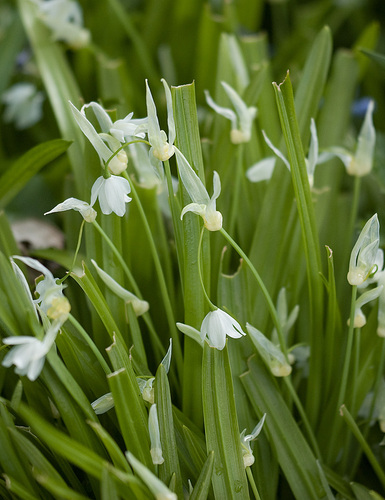
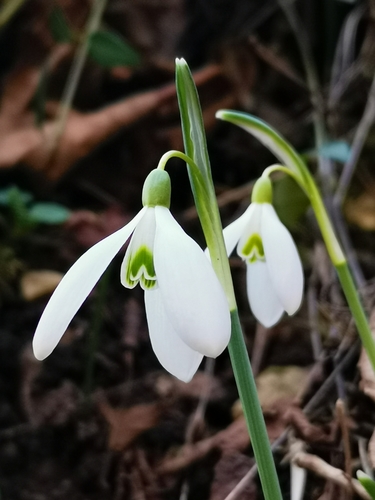
Galanthus nivalis L. reaches an approximate height of 7–15 cm, and flowers from January to April in the northern temperate zone; wild populations flower from January to May. These are perennial herbaceous plants that grow from bulbs. Each bulb typically produces two linear or very narrowly lanceolate greyish-green leaves, plus an erect, leafless flowering stalk called a scape. The top of the scape holds a pair of bract-like spathe valves joined by a papery membrane. A single, pendulous, bell-shaped white flower emerges from between these valves, carried on a slender pedicel. The flower has six tepals, also called segments. The three outer tepals are larger and more convex than the three inner tepals. The outer surface of the inner segments usually has a green or greenish-yellow V- or U-shaped (sometimes called bridge-shaped) mark over the small notch (sinus) at the tip of each tepal. The inner surface of the inner tepals has a faint green mark that covers all or most of the surface. Rarely, individual plants have green markings on the outer surface of the outer tepals. The six long, pointed anthers open via pores or short slits. The ovary is three-celled, and matures into a three-celled seed capsule. Each whitish seed has a small, fleshy tail called an elaiosome, which contains substances that attract ants; the ants distribute the seeds. Leaves die back a few weeks after flowers fade. G. nivalis is primarily a cross-pollinating plant, though self-pollination can sometimes occur. It is pollinated by bees. G. nivalis is widely cultivated in gardens, especially in northern Europe, and is widely naturalized in woodlands in the regions where it is grown. It is native to a large area of Europe, stretching from Spain in the west to Ukraine in the east. Its confirmed native range includes Albania, Armenia, Austria, Bosnia and Herzegovina, Bulgaria, Croatia, the Czech Republic, France, Georgia, Germany, Greece, Hungary, Italy, Poland, Macedonia, Moldova, Montenegro, Romania, Serbia, Slovakia, Slovenia, Spain, Switzerland, Turkey, and Ukraine. It is classified as naturalized in Great Britain, Belgium, the Netherlands, Norway, Sweden, and parts of North America, including Newfoundland, New Brunswick, Ontario, Massachusetts, Alabama, Rhode Island, Connecticut, Delaware, Indiana, Washington state, New York state, Michigan, Utah, New Jersey, Ohio, Pennsylvania, Maryland, Virginia, and North Carolina. Despite common beliefs that it is a native British wild flower or was brought to the British Isles by the Romans, current research suggests it was probably introduced much later, likely around the early sixteenth century. For information on cultivation and propagation, see Galanthus §Propagation.