About Gaillardia pulchella Foug.
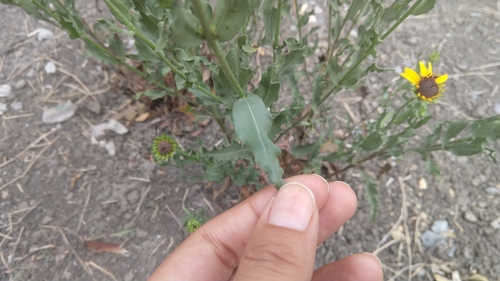
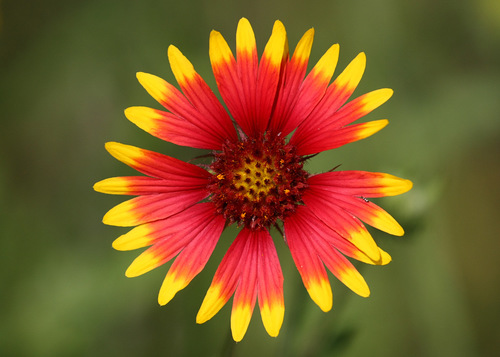
Gaillardia pulchella Foug. has an upright, hairy branching stem that grows up to 60 centimeters (24 inches) tall. Its leaves are alternate, mostly located at the base of the plant, 4–8 cm (1+5⁄8–3+1⁄8 inches) long, with margins that range from smooth to coarsely toothed or lobed; the stem is simple or branched near the base, with most leaves concentrated toward the lower portion of the plant. The plant produces daisy-like, pinwheel-shaped inflorescences that measure 4–6.5 cm in diameter. These blooms have vivid red, orange, and yellow coloration, and are surrounded by 10 to 20 ray florets that reach up to 2 cm in length, with each ligule bearing three lobes. Central disc florets of the flower head are typically more red-violet, while outer ray florets are yellow. One variety has flowers that are almost entirely red, with only the very petal tips marked with yellow. It typically blooms from May to July, but can bloom year-round in some areas. Its fruit is a hairy, almost pyramidal achene tipped with a pappus 5 to 8 millimeters (3⁄16 to 5⁄16 of an inch) long. Gaillardia pulchella is native to northern Mexico (Chihuahua, Coahuila, Nuevo León, Sonora, Tamaulipas), and the southern and central United States, ranging from Arizona east to Florida and the Carolinas, and north as far as Nebraska. It is also naturalized in scattered locations across other parts of the U.S., as well as in Québec, Ontario, China, South Africa, and parts of Central and South America. In its native range in southern North America, it generally grows on sandy plains and in deserts, is common along roadsides, prefers sandy soils, and can also grow on urban vacant lots; it is usually found below 1,000 meters (3,300 feet) above sea level. It has been introduced to the Penghu (Pescadores) Islands in Taiwan, where it is the County Flower of Penghu County, and it is called tiānrén jú (天人菊; "tianren daisy") in Chinese. In ecology, Gaillardia pulchella acts as a larval host plant for the bordered patch butterfly (Chlosyne lacinia) and the painted schinia moth (Schinia volupia), whose larvae feed on its foliage. In cultivation, Gaillardia pulchella is a hardy plant that is not particular about soil conditions, though it grows best in sandy, well-drained soil. It has high drought tolerance and thrives in dry, hot climates with full sun. In summer through late fall, its brightly colored flowers can form continuous carpets across fields and highway shoulders for miles. It is favored by honeybees, and produces a dark reddish amber honey with a buttery taste. When grown in gardens, blooms can be deadheaded to encourage further flowering, and the plant self-seeds freely.