About Gahnia sieberiana Kunth
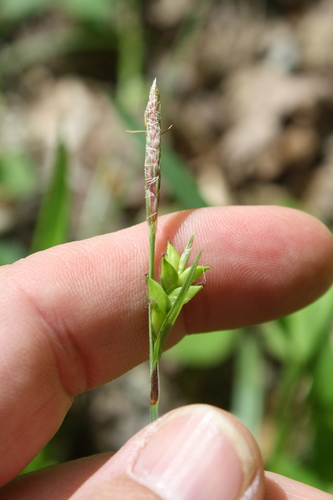
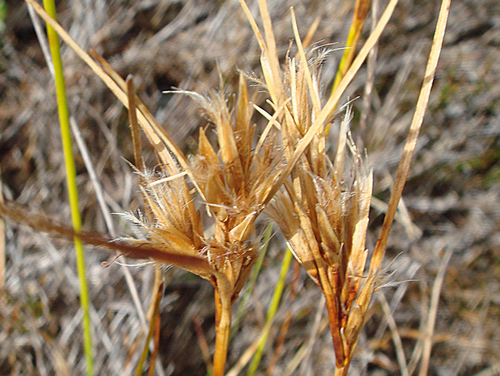
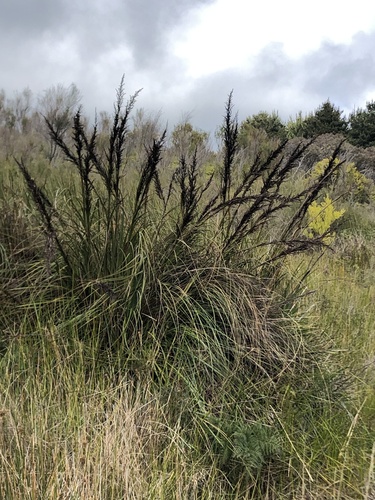
Gahnia sieberiana, commonly known as the red-fruit saw-sedge, is a tussock-forming perennial plant in the family Cyperaceae. It was first described by German botanist Carl Sigismund Kunth in 1837, and its species epithet honors Bohemian plant collector Franz Wilhelm Sieber. This species is endemic to Australia and grows widely across eastern Australia, ranging from Tasmania to North Queensland, and also occurs in Malesia, growing from sea level up to an altitude of 1,200 m (3,900 ft). It favors damp, sunny sites, and grows on both clay and sandy soils. It can grow over 2 metres (6 ft 7 in) tall, and forms a tall strappy tussock that reaches up to 2 metres (6 ft 7 in) high and wide, with rough flat leaves. Tiny sharp serrations along leaf margins can cut the hands of people handling the plant. Tall black flower spikes emerge from the center of the plant, growing up to an additional metre above the tussock, and bloom in spring and summer. After flowering, the plant produces shiny red or red-brown round nuts that measure 2.5 to 4.0 mm (0.1 to 0.2 in) long and 1.5 to 2.0 mm (0.1 to 0.1 in) in diameter. Its seeds generally germinate after bushfire. Many insect larvae, including the caterpillars of the dingy grass-skipper (Toxidia peron), montane sedge-skipper (Oreisplanus perornata), silver sedge-skipper (Hesperilla crypsargyra), flame sedge-skipper (Hesperilla idothea), golden-haired sedge-skipper (Hesperilla chrysotricha), heath sand-skipper (Antipodia chaostola), sword-grass brown (Tisiphone abeona) and northern sword-grass brown (Tisiphone helena), are recorded feeding on its leaves. In Australian gardening, Gahnia sieberiana has been suggested as a native replacement for pampas grass (Cortaderia selloana), which is classified as a noxious weed in Australia. Cultivation of this species is difficult because propagating it from seed is challenging, but existing clumps can be divided to produce new plants.