About Gahnia aspera (R.Br.) Spreng.
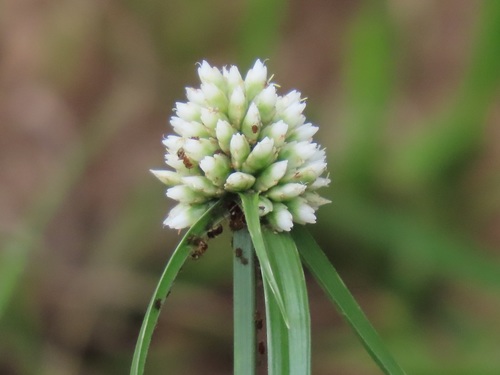
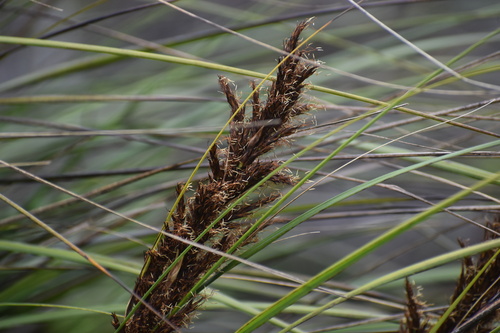
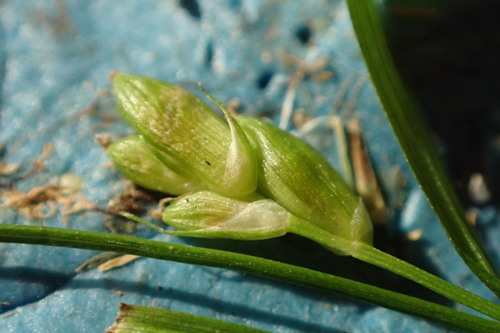
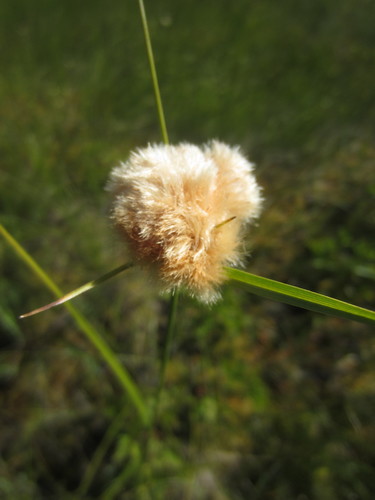
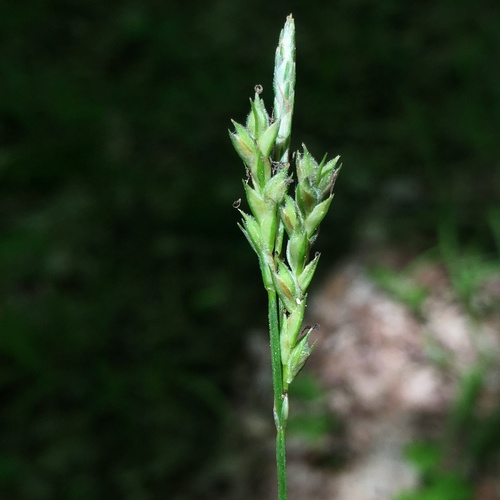
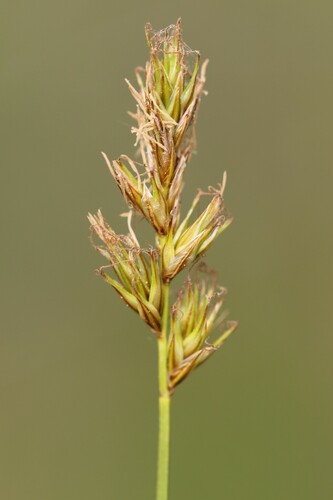
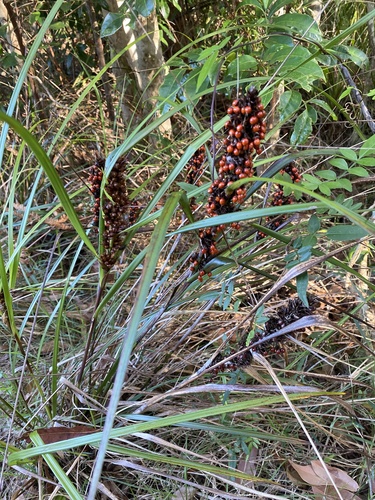
Gahnia aspera, commonly called the rough saw-sedge or round sawsedge, is a tussock-forming perennial plant that is most often found in moist locations. It grows as a strappy tussock reaching 50–100 cm (20–39 in) high and 50–150 cm (20–59 in) across, with long strap-like leaves that grow up to 80 cm long. The underside and edges of its leaves are sharp and can easily cut human skin. Originally described by botanist Robert Brown as Lampocarya aspera in his 1810 work Prodromus Florae Novae Hollandiae, the species was moved to its current genus by German botanist Curt Polycarp Joachim Sprengel in 1825. Its specific epithet aspera is the Latin word meaning "rough". Creamy flowers grow in spikes from the centre of the plant, blooming from October to January. After flowering, the plant produces shiny red or red-brown round nuts that measure 4.5 to 6.0 mm long and 2.5 to 4.0 mm in diameter. Two subspecies of Gahnia aspera are currently accepted: Gahnia aspera subsp. aspera is distributed across the Cook Islands, Fiji, Maluku Islands, New Caledonia, New Guinea, New South Wales, Ogasawara Islands, Queensland, Society Islands, Tubuai Islands, Vanuatu, and Wallis and Futuna; Gahnia aspera subsp. globosa (H.Mann) J.Kern is found only in the Hawaiian Islands on Oahu. This species grows in a wide range of habitats, from rainforest to drier inland areas including Rankins Springs and the Pilliga Scrub district in New South Wales. It is also found in Queensland, Malaysia, New Guinea and Pacific islands. The caterpillars of three skipper butterfly species—the spotted sedge-skipper (Hesperilla ornata), two-spotted sedge-skipper (Hesperilla malindeva), and flame sedge-skipper (Hesperilla idothea)—feed on the leaves of Gahnia aspera. Gahnia aspera is relatively easy to cultivate, and grows best with a moist position in the garden to produce the best foliage. It tolerates both semi-shade and full sun, and has horticultural appeal due to its attractive foliage and nuts. However, it is not widely grown because propagation by seed is difficult. In garden settings, it provides shelter for small birds such as the superb fairywren. Aboriginal Australians traditionally used the seeds of Gahnia aspera to make a type of flour.