About Gagea spathacea (Hayne) Salisb.
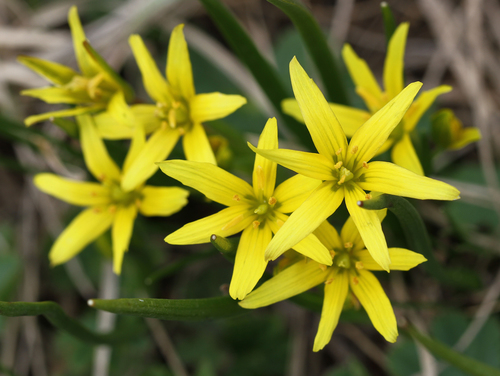
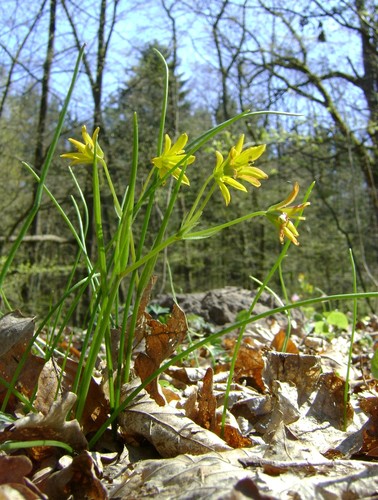
Gagea spathacea (Hayne) Salisb. is a bulbous perennial herb. Plants typically grow 15 to 20 cm tall, reaching a maximum height of 25 cm. This species produces two unequal, ovoid bulbs that measure 10 to 18 mm long and 6 to 10 mm wide. The pair of bulbs is enclosed by a single leathery bright-brown tunic, and up to 54 small lateral bulbils form outside this tunic. One erect, solitary, unbranched, glabrous stem and two basal leaves grow from the bulbs. The basal leaves are usually longer than the plant’s inflorescence, and only rarely equal it in length; they are hollow, glabrous, 15 to 20 cm long (reaching up to 28 cm), and 1 to 1.5 mm wide. A single oblong-lanceolate, hood-shaped, glabrous cauline leaf is present on the stem. There are two glabrous bracts: the lower bract is spatulate, 40 to 80 mm long, 4 to 6 mm wide, marked with 8 to 13 veins, and is slightly longer than the inflorescence or nearly equal in length; the upper bract is linear-lanceolate, marked with 3 to 5 veins, 15 to 25 mm long, 1 to 2 mm wide, and positioned 3 to 17 mm above the lower bract. Flowering occurs from April to May, and the inflorescence is an umbel holding 1 to 5 flowers. Pedicels are 30 to 45 mm long and glabrous. Linear, glabrous bracteoles 2 to 15 mm long are located at or slightly above the base of each pedicel. The perianth consists of 6 free, linear-lanceolate, obtuse segments 10 to 13 mm long, which are yellow on the inner surface and greenish-yellow on the outer surface. Six stamens are inserted at the base of the perianth, with basifixed anthers. Fruits are loculicidal, subglobose capsules. This perennial bulbous plant is distributed across northern, central, and eastern Europe. It is most common in northern Germany and adjacent regions including southern Scandinavia and Poland. A large share of the world’s total Gagea spathacea population occurs in Germany, particularly in the federal state of Mecklenburg-Western Pomerania. The species is rarer in western and southern parts of Europe. It has been recorded from Denmark, Sweden, France, most of Central Europe, the former Yugoslavia, Belarus, Ukraine, and Russia, including the northern Caucasus. The sources cited for this information are: Brunet, Jörg; Von Oheimb, Goddert (2009). "Migration of vascular plants to secondary woodlands in southern Sweden". Journal of Ecology. 86 (3): 429–438. doi:10.1046/j.1365-2745.1998.00269.x; European Environment Agency (2012). "Pannonic hygrophile ash-oak-hornbeam forests". Retrieved 7 September 2013; Peterson, A.; John, H.; Koch, E.; Peterson, J. (2004). "A molecular phylogeny of the genus Gagea (Liliaceae) in Germany inferred from non-coding chloroplast and nuclear DNA sequences". Plant Systematics and Evolution. 245 (3–4): 145–162. doi:10.1007/s00606-003-0114-y. ISSN 0378-2697; Pfeiffer, Tanja; Klahr, Anja; Heinrich, Anita; Schnittler, Martin (April 2011). "Does sex make a difference? Genetic diversity and spatial genetic structure in two co-occurring species of Gagea (Liliaceae) with contrasting reproductive strategies". Plant Systematics and Evolution. 292 (3–4): 189–201. doi:10.1007/s00606-010-0404-0. ISSN 0378-2697; Pfeiffer, Tanja; Klahr, Anja; Peterson, Angela; Levichev, Igor G.; Schnittler, Martin (May 2012). "No sex at all? Extremely low genetic diversity in Gagea spathacea (Liliaceae) across Europe". Flora – Morphology, Distribution, Functional Ecology of Plants. 207 (5): 372–378. doi:10.1016/j.flora.2012.03.002. ISSN 0367-2530; Terrier, Charles-A (1957). "Note sur le charbon des Gagées : Ustilago ornithogali (Schm. et Kze) magnus" (PDF). Bulletin de la Murithienne (in French) (74): 75–76. Retrieved 7 September 2013; Toussaint, Benoît, ed. (2011). "Gagea spathacea". Les plantes protégées et menacées de la région Nord-Pas de Calais (in French) (2 ed.). Centre régional de phytosociologie agréé Conservatoire botanique national de Bailleul, avec la collaboration du Collectif botanique du Nord-Pas de Calais. Archived from the original on 3 March 2016. Retrieved 28 August 2013; E.J. Weeda (March 2006). "Waar de Schedegeelster (Gagea spathacea) zich thuis voelt" (in Dutch). Archived from the original on 28 September 2013. Retrieved 10 September 2013; Westergård, Mogens (1936). "A cytological study of Gagea spathacea with a note on the chromosome number and embryo-sac formation in Gagea minima". Comptes Rendus des Travaux du Laboratoire Carlsberg Série Physiologique. 21 (18): 437–451.