About Furnarius longirostris Pelzeln, 1856
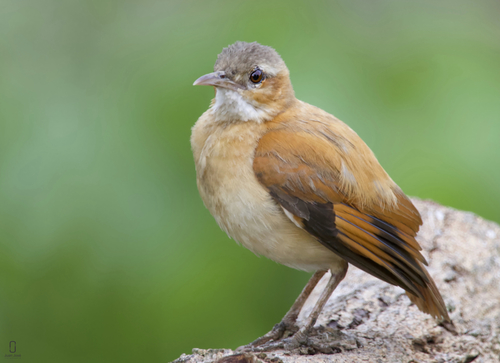
Caribbean hornero (scientific name Furnarius longirostris Pelzeln, 1856) is a medium-sized hornero that measures 17 to 19 cm (6.7 to 7.5 in) in length. It has a long, somewhat decurved bill. Subspecies of this bird show very little difference from one another, and males and females have identical plumage. Adult Caribbean horneros have a wide white supercilium, a narrow brownish gray stripe running behind the eye, tawny ear coverts, and a tawny-rufous malar area. Their crown is gray. Their back, rump, wing coverts, and uppertail coverts are bright orange rufous. Their tail is chestnut. Their flight feathers are blackish with a rufous band. They have a white throat, and the rest of their underparts are a rich cinnamon-buff. Their iris is dark brown, their upper mandible is mostly dark, their lower mandible is pale, and their legs and feet are pale pinkish. The Caribbean hornero ranges from the Córdoba and Antioquia departments of northern Colombia eastwards into northwestern Venezuela, reaching Falcón state. It lives in a wide range of semi-open to open lowland landscapes, including riparian gallery forest and woodlands, secondary forest edges, agricultural areas, and town parks and gardens. It prefers habitats located near water, and most individuals occur at elevations below 1,500 m (4,900 ft).