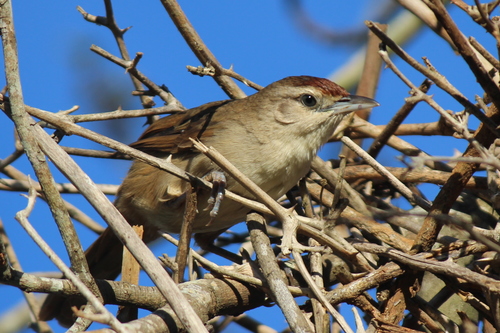
About Furnarius leucopus Swainson, 1838
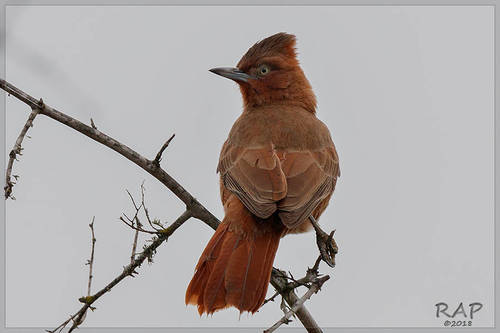
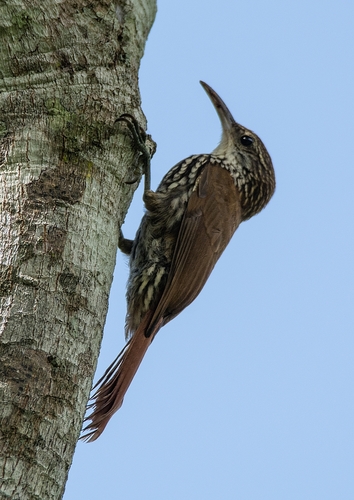
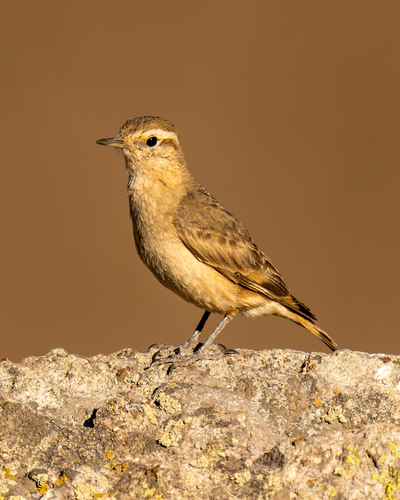
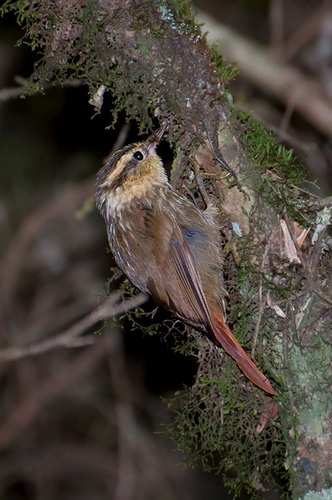
The pale-legged hornero (scientific name Furnarius leucopus Swainson, 1838) measures 15 to 18 cm (5.9 to 7.1 in) long and weighs approximately 37 to 49 g (1.3 to 1.7 oz). It is a medium-sized hornero with a long, nearly straight bill. The plumage of males and females is identical. Adults of the nominate subspecies F. l. leucopus have a wide whitish supercilium, brownish gray ear coverts, and a tawny-rufous malar area. Their crown is dark rufescent brown, and their back, rump, and uppertail coverts average bright orange rufous, ranging between tawny rufous and rufous amber. Their tail is chestnut, their wing coverts are chestnut, and their flight feathers are blackish with a wide chestnut band. Their throat is white, fading to tawny-ochraceous on the breast. Their flanks are paler tawny-ochraceous, the center of their belly is nearly whitish, and their undertail coverts are whitish with dark brown bases. Their iris is usually reddish brown or chestnut, and gray-brown or gray in the tricolor subspecies. Their maxilla is dusky horn at the base with a paler culmen and tip, and their mandible is also pale. Their legs and feet are pale pinkish, pearly gray, or whitish. Juveniles resemble adults, but have a noticeably shorter bill and differently shaped flight and tail feathers. Subspecies F. l. tricolor has a grayer crown, more ochraceous back, and paler wings and tail than the nominate subspecies. F. l. assimilis has a lighter, more ochraceous rump, wings, and tail than tricolor, and a paler wing band. F. l. araguaiae is intermediate between tricolor and assimilis, with a brighter back than tricolor and a smaller wing band. The subspecies of the pale-legged hornero have the following distributions: F. l. leucopus along the Negro and Branco rivers in northern Brazil and southwestern Guyana; F. l. tricolor in eastern Peru, western Brazil extending east into Pará, and Bolivia as far as Santa Cruz Department, with one recorded sighting in southeastern Ecuador; F. l. araguaiae in western Tocantins and eastern Mato Grosso states in central Brazil along the Araguaia and das Mortes rivers; F. l. assimilis in eastern and southern Brazil between Maranhão, Pernambuco, and Mato Grosso do Sul, and extreme southeastern Bolivia. The pale-legged hornero lives in a wide range of semi-open to open landscapes, including gallery forests along rivers, edges of secondary forest, agricultural areas, and town parks and gardens. It favors humid areas, usually near water. It mostly occurs at elevations below 1,100 m (3,600 ft); it rarely exceeds 400 m (1,300 ft) in Bolivia, and locally reaches 1,700 m (5,600 ft) in Peru.