About Furnarius cristatus Burmeister, 1888
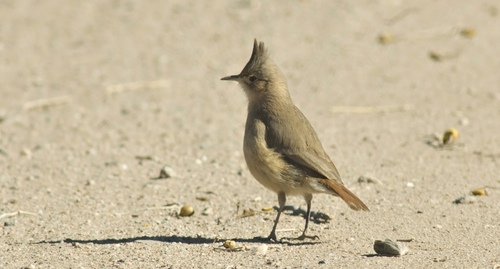
Furnarius cristatus Burmeister, 1888, commonly called the crested hornero, is 14 to 15 cm (5.5 to 5.9 in) long and weighs 26 to 29 g (0.92 to 1.0 oz). It is a small hornero, with the shortest bill of any species in its genus. Its most distinctive feature is its crest, which is unique among all horneros. Male and female crested horneros have identical plumage. Adult crested horneros have a faint pale supercilium, and a dull brownish malar area and ear coverts; the ear coverts have indistinct darker edges. Their forehead is rufescent, while their crown and its attached crest are a duller clay-brown. Their back and rump are dull tawny-rufous, and their uppertail coverts are rufous. The central pair of feathers on their tail are dull rufous, and all other tail feathers are a brighter rufous. Their wing coverts and flight feathers are mostly dull tawny-brown, with rufous edges on the flight feathers. Their throat is whitish, their breast is tawny, and their belly and flanks are a deeper tawny, with a whitish center to the belly. Their undertail coverts are tawny whitish, with rufescent-brown bases. Their iris is brownish-red, their maxilla is blackish, their mandible is pinkish with a dark tip, and their legs and feet are gray. The crested hornero ranges from extreme southeastern Bolivia and western Paraguay south into Argentina, reaching as far as the central Argentine provinces of San Luis, Córdoba, Santa Fe, and Entre Ríos. It lives in several types of arid landscapes, including lowland scrublands, higher elevation Gran Chaco scrub, and woodlands. It can be found at elevations up to 1,000 m (3,300 ft).