About Fumaria muralis Koch
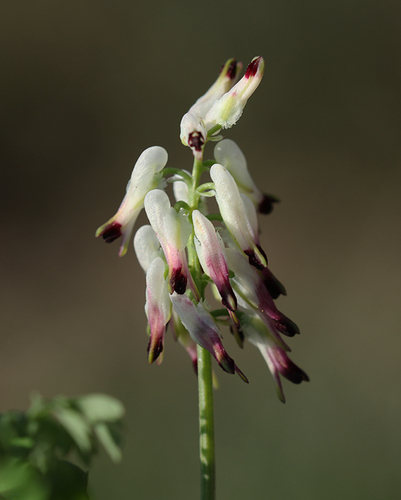
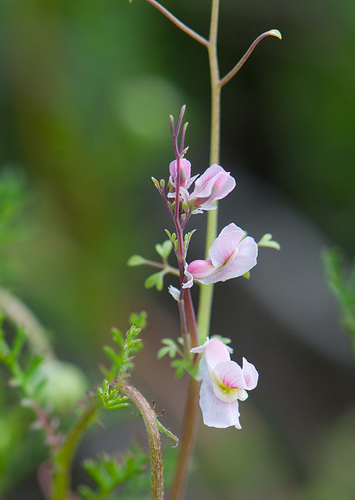
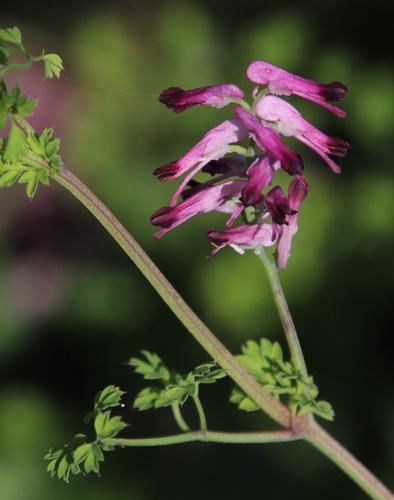
Fumaria muralis Koch is a delicate annual plant that blooms in spring. It is most easily identified by its pink flowers, which have dark red or purple tips, with roughly twelve flowers growing per inflorescence. Its stems start out erect, then later become sprawling or climbing. The stems are weak, heavily branched, hairless, and can reach up to 1000 mm (39.4 in) in length. Its leaves range in color from green to glaucous-green, and are polyternate and 2- to 4-pinnatisect, with narrowly elliptic or oblong final-order segments. The first leaves grow singly, are 7–15 mm (0.3-0.6 in) long with a 7–15 mm (0.3-0.6 in) stalk, and bear three hairless leaflets. Leaves that emerge later become more compound and lobed. Mature leaves are deeply lobed three times, with three or more leaflets that are 3–15 mm (0.1-0.6 in) long. Alternate leaves form a rosette. Leaf segments range from egg-shaped to triangular, are usually three-lobed, and are hairless. The leaf blade is gray-green to blue-green, flat, and reaches up to 80 mm long by 40 mm wide (3.2 x 1.6 in). Flowers are grouped into axillary racemes. Each pedicel is subtended by a linear bract, and is either straight or curved outward when the plant produces fruit. The corolla is pink, sometimes lightly pink, and dark red or purple at the apex; it measures 9–12 mm (0.35-0.47 in) in length. It is made of four petals: the outer upper and lower petals are free, while the two inner petals are fused into a tube that is closed at the apex. The upper petal extends into a spur at its base and ends with two upturned wings, while the lower petal has two narrow, spreading or erect wings. The stigma has three lobes, and the central lobe is distinctly smaller than the other two. Two sepals attach laterally to the corolla; these sepals are whitish with a green midrib, shaped ovate to broadly oblong, with toothed margins along the lower two-thirds of their edge. They measure 3–5 mm (0.12-0.2 in) long and 1.5–3 mm (0.06-0.12 in) wide. The fruit is an achene that is globose to broadly ovate, with a surface that is almost smooth to slightly rugose, or wrinkled.
Fumaria muralis is native to the temperate and Mediterranean regions of western Europe and western North Africa. Within its native range, it occurs in Macaronesia, Portugal, France, Belgium, Germany, the United Kingdom, Ireland, and Norway. Outside of its native range, it can be found in Spain, the Netherlands, Denmark, Japan, New Zealand, Australia, South Africa, and the United States. It prefers to grow in open, bare patches, and is classified as a weed of pastures, roadsides, gardens, footpaths, coastal shrublands, and disturbed areas.