About Fulica atra Linnaeus, 1758
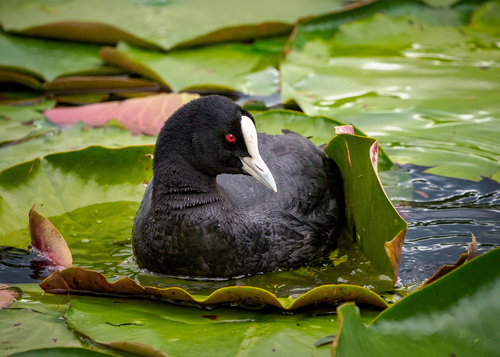
The Eurasian coot, with the scientific name Fulica atra Linnaeus, 1758, measures 36–38 cm (14–15 in) in length and has a wingspan of 70–80 cm (28–31 in). Males weigh around 890 g (31 oz), while females weigh around 750 g (26 oz). Its plumage is mostly black, with the only exceptions being its white bill and white frontal shield; this white shield is the origin of the idiom "as bald as a coot", which has been in use since 1430. As a swimming species, the coot has partial webbing on its long, strong toes. Males and females have similar appearances. Juvenile Eurasian coots are paler than adults, have a whitish breast, and lack the adult's facial shield. Adult black plumage develops when juveniles are around 3–4 months old, but the full white shield only finishes developing at approximately one year old. The Eurasian coot is a noisy bird with a broad repertoire of crackling, explosive, or trumpeting calls, which it often makes at night. This coot breeds across most of the Old World, nesting on freshwater lakes and ponds. Like its relative the common moorhen, it has adapted well to urban environments, and is frequently found in parks and gardens with access to water. It lives and breeds in Europe, Asia, Australia, and Africa, and has recently expanded its range into New Zealand. Populations are resident in the milder portions of the species' range, but coots from most of Asia migrate further south and west in winter when waters freeze over. It has been recorded as a vagrant in North America. Compared to most members of the rail family, the Eurasian coot is far less secretive. It can be seen swimming on open water or walking across grassy areas along shorelines. It is an aggressive species, and is strongly territorial during the breeding season; both parents take part in defending their territory. Outside of the breeding season, Eurasian coots may gather in large flocks, a behavior that may help them avoid predators. The species is reluctant to fly, and when it does take off it runs across the surface of the water while creating a great deal of splashing. It also performs this running behavior without actually flying when traveling short distances at speed during territorial disputes, or when moving across land to escape intruders. Like many other rail species, its flight is weak and does not look stable, but during migration (which usually happens at night) it can travel surprisingly large distances. When swimming, it bobs its head, and makes short dives after a small jumping start. When fighting other waterbirds, especially other Eurasian coots, it attacks by charging its opponent and striking the opponent with its long legs.