About Fulica armillata Vieillot, 1817
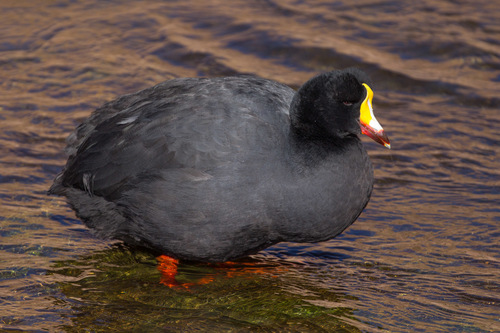
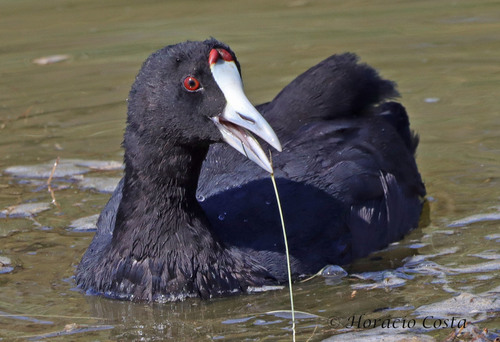
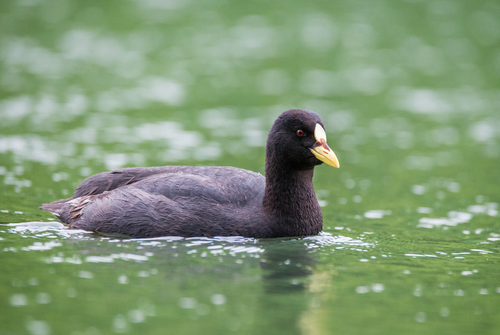
The red-gartered coot (Fulica armillata Vieillot, 1817) measures 43 to 51 cm (17 to 20 in) in length, and males and females have identical appearance. Adults have a yellow bill and yellow frontal shield, with a red patch between the two; the bill may sometimes appear reddish. Their legs range from orange-yellow to yellow, with a distinctive pale red "garter" band above the ankle. The species' plumage is overall slaty gray, and is darker black on the head and neck. Its undertail coverts are white. Immature birds have a paler bill than adults, and olive-colored legs and feet. Juvenile red-gartered coots are drab gray-brown, with dusky mottling over a white head and neck.
The red-gartered coot is distributed from central and southern Chile, Paraguay, and southeastern Brazil, extending south through Argentina to Tierra del Fuego. It has occurred as a vagrant on the Falkland Islands, and unconfirmed sight records from Bolivia lead the South American Classification Committee of the American Ornithological Society to classify the species as hypothetical there. Fossils of the red-gartered coot have been recovered from Chile's Laguna de Tagua Tagua formation.
This coot lives in large ponds, lakes, rivers, and marshes, and uses sheltered marine bays during the winter. It is primarily a lowland species, but occurs at elevations up to about 1,200 m (3,900 ft) in Patagonia, up to 1,000 m (3,300 ft) in the southern Andes, and as high as 2,100 m (6,900 ft) in northwestern Argentina.