About Fulica ardesiaca Tschudi, 1843
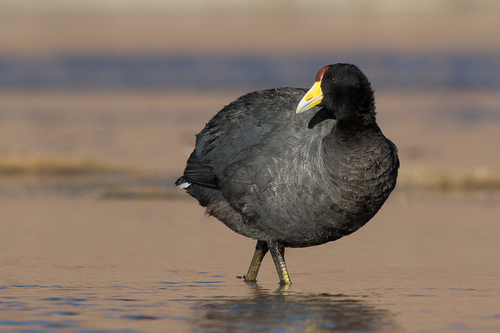
Fulica ardesiaca Tschudi, 1843, commonly called the Andean coot, measures 40 to 43 cm (16 to 17 inches) in length. The species has two distinct color morphs, which occur in both of its recognized subspecies. Both morphs are primarily slaty gray overall, with darker black coloration on the head and neck. Their secondaries typically have white tips. The first morph has a chrome yellow bill that becomes paler yellow and sometimes green at the tip, paired with a deep chestnut frontal shield, and green legs and feet. The second morph has a white bill, a frontal shield ranging from white to orange-yellow, and slaty gray legs and feet. Regardless of individual color morph, the two subspecies differ only in the color of their undertail coverts: the undertail coverts of the nominate subspecies are white, while those of F. a. atrura are almost black.
The nominate subspecies of Andean coot occurs in the Andes from northern Peru south through western Bolivia, extending into northern Chile as far as the Antofagasta Region and into northwestern Argentina as far as Catamarca Province. F. a. atrura occurs along the Andes from southern Colombia through Ecuador into far northern Peru, and is also found in coastal Peru. Fossils tentatively identified as belonging to this species have been recovered from the Laguna de Tagua Tagua formation in Chile. The Andean coot most often lives on large lakes with extensive vegetation in their shallow areas, though it can also be found in sparsely vegetated lakes, as well as ponds, marshes, and rivers. Red-fronted birds (corresponding to the first color morph) tend to be the dominant morph in vegetated lakes, while white-fronted birds (the second color morph) dominate in less vegetated lakes at higher elevations. The nominate subspecies is found at elevations ranging from 2,100 to 4,700 m (6,900 to 15,400 ft). F. a. atrura occurs between 2,200 and 3,600 m (7,200 to 11,800 ft) in Colombia, and is found at lower elevations in Ecuador and Peru.