About Fulica americana Gmelin, 1789
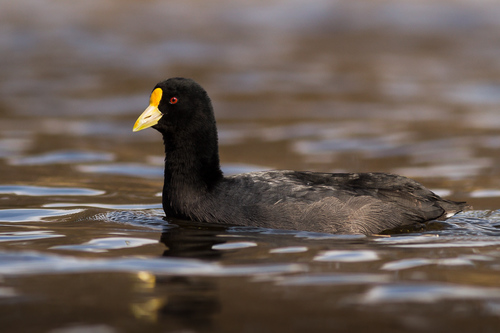
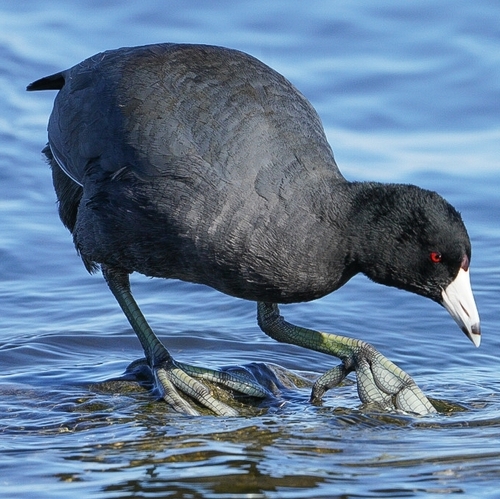
Description: The American coot (scientific name Fulica americana Gmelin, 1789) measures 34–43 cm (13–17 in) in length, with a wingspan ranging from 58 to 71 cm (23 to 28 in). Adult American coots have a short, thick white bill and a white frontal shield, which usually features a reddish-brown spot near the top of the bill, between the eyes. Males and females have similar appearance, but females are smaller in size. Female body mass ranges from 427 to 628 g (0.941 to 1.385 lb), while male body mass ranges from 576 to 848 g (1.270 to 1.870 lb). Juvenile American coots have olive-brown crowns and gray bodies, and develop full adult coloration around 4 months of age.
Distribution and habitat: American coots live near reed-ringed lakes and ponds, open marshes, and slow-moving sluggish rivers. They prefer freshwater environments, but may temporarily occupy saltwater environments during the winter months. The species' breeding habitat extends from marshes in southern Quebec to the Pacific coast of North America, and reaches as far south as northern South America. Birds breeding in temperate North America east of the Rocky Mountains migrate to the southern United States and southern British Columbia in winter. American coots are year-round residents in areas where water stays open through winter. The population of American coots that remain year-round near the northern limit of the species' range appears to be increasing.
Autumn migration takes place from August to December; males and non-breeding birds move south before females and juveniles. Spring migration back to breeding ranges occurs from late February to mid-May, with males and older birds moving north first. There is documented evidence of individual American coots traveling as far north as Greenland and Iceland.
Behavior and ecology: The American coot is a highly gregarious species, especially during winter, when its flocks can number in the thousands. When swimming at the water surface, American coots form a variety of distinct collective formations, including single-file lines, high-density synchronized swimming with rotational dynamics, broad arcing formations, and sequential take-off dynamics.