About Fuchsia magellanica Lam.
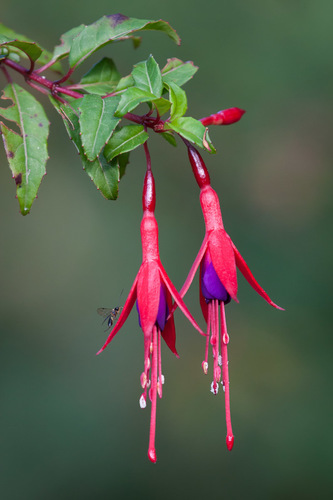
This sub-shrub, Fuchsia magellanica Lam., has long arcuate stems. In frost-free climates, it reaches 1–3 metres (3.3–9.8 ft) in both height and width; in colder climates, it reaches 1.2–1.5 metres (4–5 feet). Its leaves grow in whorls of 3 to 4 per node, or are sometimes opposite. The leaves are ovate to lanceolate, 2.5-6 cm long, and 1-2 cm wide, with serrate margins and 0.5-1 cm long petioles. The plant blossoms profusely over a long period, producing many small, tubular, pendent flowers that come in brilliant shades of red and purple, softer shades of pink and lavender, and sometimes white. These perfect flowers are axillary and pendent, with 3-4.5 cm long peduncles, a 10-13 mm long magenta floral tube, 20-25 mm long magenta sepals, and 10-13 mm long dark purple petals that become convolute after anthesis. Its stamens are exserted, with 25-30 mm long filaments. The berries are ellipsoid, 10-15 mm long, and 0.7-0.9 mm wide. The chromosome count of this species is 2n = 44. F. magellanica is consistently variable across its entire natural range. Despite past usage and popular misconceptions, no scientific varieties are currently recognized by Dr. Paul E. Berry, the leading authority on the Fuchsia genus. Garden selections and hybrids should not be given taxonomic status by using the "var." designation. Pollen stain tests conducted in the U.S. Pacific Northwest by members of the Western Fuchsia Species Society indicate that almost all garden selections of this species are hybrids, to varying degrees. It can be distinguished from other species in its section by its elongated ovary and fruit, long petioles that are usually over 1/4 the length of the leaf blade, and highly dentate leaf margins. This Fuchsia species is native to temperate southern regions of Argentina and Chile, ranging from latitude 32°50' S. to the Straits of Magellan. It thrives in damp scrublands, forest edges, or clearings, often growing near water sources. It is geographically separated from Brazilian species of the Quelusia section by 1000-1500 km. It has become naturalized in the Australian states of Western Australia, South Australia, New South Wales, Victoria and Tasmania. This plant was introduced to England in the late 18th century. According to tradition, English gardener James Lee discovered the species on the windowsill of a seaman's house and purchased it for a considerable sum. As early as 1793, Lee is said to have sold a large number of cuttings propagated from this single original plant. Fuchsia magellanica, along with its cultivars and hybrids, is widely cultivated by plant nurseries and gardeners as an ornamental plant. It is grown in temperate and subtropical gardens and conservatories, and can be grown in containers on patios and balconies, or kept indoors. It prefers a sunny growing position. Compared to more tropical Fuchsia species, this plant is quite cold-hardy: it is deciduous in areas with light frosts, and only its top growth dies back after hard frosts when mulched. Its profuse drooping flowers produce nectar that attracts hummingbirds. This species, and hybrids that use it as parent stock, are very susceptible to fuchsia gall mite (Aculops fuchsiae), a serious disfiguring pest. The mite was accidentally spread from its native Brazil to the West Coast of the United States in 1980, and has more recently been recorded in France (2003), the Channel Islands (2006) and the United Kingdom (2007). Fortunately, fuchsia gall mite does not readily survive temperatures below 4 °C (40 °F), and effective treatments and management strategies exist. Fuchsia magellanica has been used in traditional remedies as a diuretic and antipyretic.