About Fuchsia excorticata (J.R.Forst. & G.Forst.) L.fil.
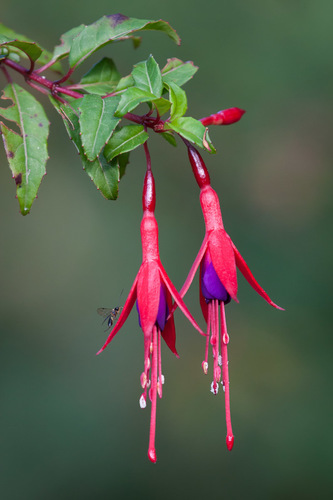
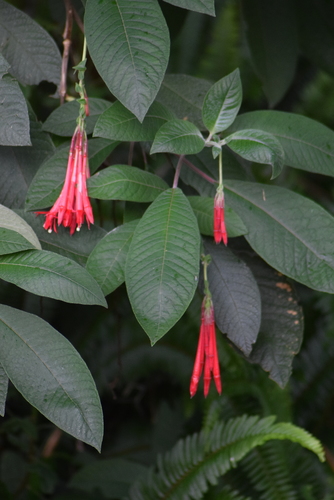
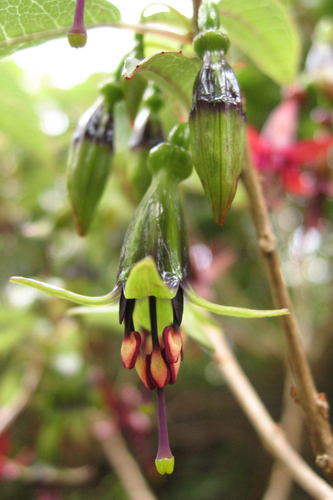
Fuchsia excorticata, also known by its Māori name kōtukutuku, is a gynodioecious, deciduous tree species in the Onagraceae family. It can reach up to 13 metres (40 feet) tall, with a twisted trunk growing to 70 cm (30 inches) in diameter. The tree branches within several metres from its base, forming a broad, spreading canopy. This is the largest species in the Fuchsia genus; most other Fuchsia species grow as shrubs or small trees, and F. excorticata evolved in New Zealand to reach this much greater size. It is well known for its distinctive shredding bark, which ranges in colour from copper and orange to reddish-brown. The bark naturally peels away in thin paper-like sheets, exposing a smooth, pale green cambial layer in the inner bark. Its leaves grow up to 10 cm (4 inches) long and 1.5 to 3 cm (0.6 to 1 inch) wide. They are glabrous, slightly strigose, and have a tip that ranges from acute to rounded. The upper leaf surface is medium to dark green, while the underside is silver or white. Fuchsia excorticata is one of only a few deciduous tree species native to New Zealand. Throughout most of its range in the South Island and mountainous areas of the North Island, it loses its leaves in autumn and regrows new leaves in spring, though some North Island populations retain their leaves year-round. Populations of fully deciduous trees have been recorded as far north as Auckland. A 1936 study conducted in Dunedin found that leaf fall begins in early May and lasts three to four weeks; the tree stays leafless until new shoots emerge in August or September. Flowering occurs mostly between August and December. Flowers grow individually, though the tree can sometimes develop cauliflory, where flowers grow directly from older stems or the main trunk. Ovaries are 4.5 to 8 mm long, 1.7 to 3 mm thick, and green in colour. Sepals are narrow-triangular, 8 mm long, 3 mm wide at the base, and glossy green, with dull purple streaks on the upper sections between the ridges, shifting to red or crimson in the middle of the sepal. Petals are dark purple, 1.8 to 5 mm long, and 0.7 to 2.1 mm wide at their midpoint. Filaments range from purple to pale cream, with lengths of 6 to 15 mm and 5 to 10 mm. Pollen-producing anthers are also purple, measuring 1.8 to 2.5 mm long and 1 to 1.7 mm thick. Styles are green to yellow and 22 to 40 mm long. Stigmas are yellow to green, 1.8 to 2.2 mm long and 1.4 to 2.1 mm wide. This species produces distinctive blue pollen, which gets its colour from anthocyanin pigments: specifically kaempferol-3-sophoroside and quercetin-3-sophoroside. Fruits are black to dark purple, 9 to 13 mm long and 5 to 8 mm thick. Seeds are tan, 0.75 to 1 mm long and 0.3 to 0.6 mm broad, with each fruit containing between approximately 320 and 670 seeds. Fuchsia excorticata has a gametic chromosome count of n=11. Fuchsia excorticata is endemic to New Zealand, and is the most widely distributed Fuchsia species in the South Pacific. Its range covers the majority of the North and South Islands, and it can be found as far south as the Auckland Islands, where it has only been recorded at a single location: Laurie Harbour in Port Ross. In 1980, New Zealand ecologist Colin Meurk documented the species scattered along a small tributary at around 75 m (200 ft) elevation on the south side of Grey Duck Creek, 200 m (700 ft) from the mouth of Laurie Harbour during an Auckland Islands expedition. It is uncommon on Stewart Island, where its population has been reduced by browsing mammals; it likely never became a dominant tree there due to the island’s low soil fertility. There is a naturalised population on the Chatham Islands, introduced by humans. Godley & Berry (1995) noted that a 1976 visitor to the island reported F. excorticata was introduced there roughly 90 years prior, around the 1880s. In 2023, the species was assessed as "Not Threatened" under the New Zealand Threat Classification System. In the 2024 revision of the IUCN Red List, its conservation status is "Least Concern", with an evaluated population trend of "Unknown". Fuchsia excorticata most commonly occurs in lowland and montane ecosystems, and is often found along streams and forest margins. It has a broad altitudinal range, growing from 0 to 1,050 m (0 to 3,445 ft) above sea level. It can establish in most soil conditions, but generally prefers riparian soils, and can act as a predecessor species for areas with poor soil or site conditions. In river-bed forests, where it often grows, soil typically consists of a surface humus layer overlying a layer of river shingle. It prefers shaded conditions but can still grow well in full sun. It is commonly found in mixed angiosperm-podocarp forests or Nothofagus (beech) forests, and is also common in other disturbed forest areas. In riparian plant communities near rivers, Fuchsia excorticata is often associated with wineberry (Aristotelia serrata), māhoe (Melicytus ramiflorus), and koromiko (Veronica salicifolia). It can display colonial growth habits, particularly after glacier retreat or deforestation. The fruits of Fuchsia excorticata are dispersed by frugivorous (fruit-eating) animals. They are an important food source for many native New Zealand birds, and are especially important for kererū (Hemiphaga novaeseelandiae). Other native birds including tūī (Prosthemadera novaeseelandiae) and New Zealand bellbird (Anthornis melanura) regularly eat the fruits. In 1964, Beveridge estimated that a single dropping from an introduced blackbird (Turdus merula) produced 178 Fuchsia excorticata seedlings, confirming blackbirds are effective seed distributors for this species. The fruits are also eaten by the flightless kākāpō (Strigops habroptilus): German-born New Zealand explorer Julius von Haast recorded observing a kākāpō sitting 10 feet above ground on a Fuchsia tree and eating its berries. Fuchsia excorticata has a gynodioecious breeding system, meaning individual trees are either hermaphroditic or female. According to Robertson et al. (2008), hermaphroditic individuals occur at higher frequencies than female individuals. It is pollinated by birds, primarily bellbirds and tūī. Stitchbirds (Pogonornis cincta), silvereyes (Zosterops lateralis), and bumblebees (Bombus spp.) have also been recorded visiting its flowers. Evidence from a 2012 study indicates that the upland moa (Megalapteryx didinus) fed on its nectar. Green flowers of this species stand out against the tree’s orange bark, produce more nectar, and are more attractive and rewarding to bird pollinators than red flowers. New Zealand botanist Eric Godley proposed that Fuchsia excorticata is capable of self-pollination when pollinators are absent. The introduction of the common brushtail possum to New Zealand has caused population declines of Fuchsia excorticata. The species is one of the possum’s preferred food sources, and possums will browse individual trees until they are completely defoliated, which can kill the tree. It also acts as a host for the endemic lemon tree borer (Oemona hirta). Wyman et al. (2011) studied interactions between tree wētā (Hemideina spp.) and Fuchsia excorticata, and found that tree wētā consume the species’ seeds. Fuchsia excorticata has very low flammability. A 2025 study published in the American Journal of Botany found that the species has moderate ignition percentage, moderate burn time, and moderate amount of biomass burned.