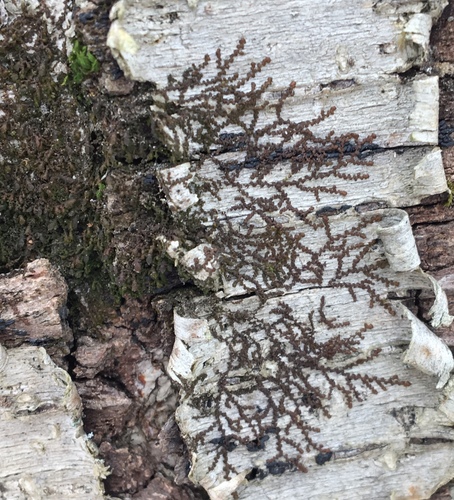
About Frullania eboracensis Lehm.
Nomenclature and Taxonomy
Frullania eboracensis, commonly called New York scalewort or Ralsei's Scalewort, is a liverwort species belonging to the family Frullaniaceae.
Morphological Distinction Overview
This species can be distinguished from other scalewort species by its specific morphological traits.
Vegetative Morphological Traits
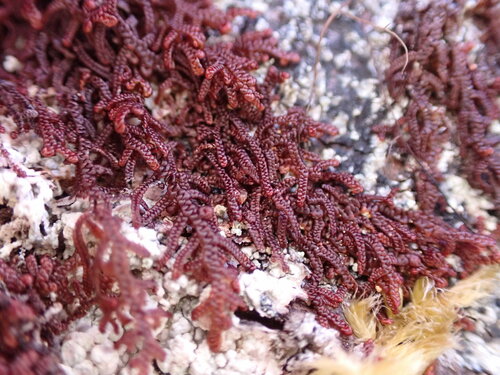
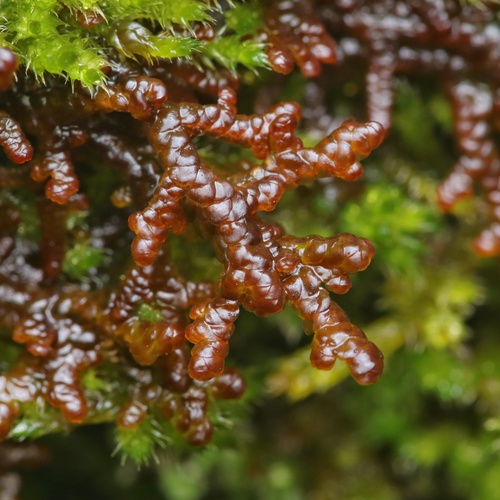
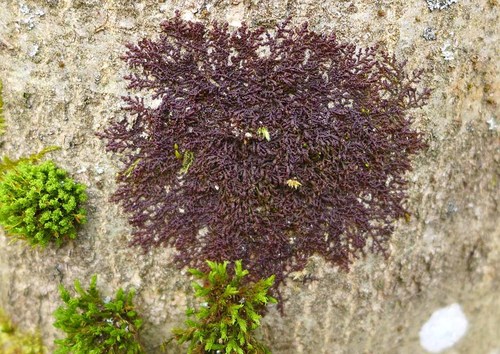
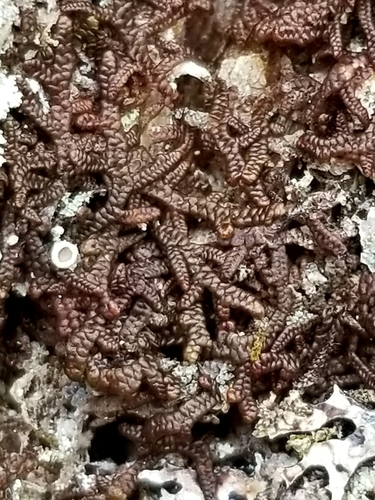
These include its small overall size, with leafy shoots measuring only 0.8–1 mm across; lower leaf lobes that are roughly as long as they are wide, and reach one-third to one-half the size of the upper leaf lobes; and underleaves that measure 0.15 mm across, only slightly wider than the 0.10 mm wide stems they grow on.
Underleaf and Perianth Traits
The underleaves have toothless or nearly toothless lateral margins, and the species' perianths have smooth to slightly roughened keels along their sides, rather than tuberculate keels.
Microscopy Requirement for Identification
Despite these distinct morphological features, microscopy is often required to confidently separate New York scalewort from other species in the genus Frullania.
Microscopic Diagnostic Trait
A key diagnostic trait visible under microscopy is the irregular, jagged edges of leaf cells, with cell walls that are swollen at intervals.
Geographic Distribution
New York scalewort is widely distributed across eastern North America and adjacent areas of southern Canada.
Common Habitat Types
It grows in a range of damp shaded habitats: most commonly on the bark of trees, particularly trees growing on rocky bluffs, along wooded slopes, in both upland and lowland woodlands, along streams and ponds, and in swamps.
Alternative Substrate Habitats
It can also grow on exposed tree roots, fallen logs, and wooden fence planks in suitable damp, shaded locations.
Host Tree Species
It is found primarily on the bark of deciduous trees, including oak, maple, ash, elm, eastern red cedar, hackberry, cottonwood, beech, and musclewood.
Easily Spotted Host Substrates
It is most easily spotted growing on trees with gray bark, such as red maple, beech, holly, and some oaks.
Preferred Growth Position on Trees
It usually grows on the trunks of natural, older, mature trees, rather than on branches, exposed roots, or younger or cultivated trees.
Reproductive System
New York scalewort is dioecious, meaning male and female reproductive organs form on separate individual plants.
Male Reproductive Morphology
Male plants produce reproductive organs on short lateral branches that bear several pairs of leaf-like bracts; these bracts are similar to the plant's regular leaves, but are somewhat smaller.
Female Reproductive Position
Female plants produce reproductive organs at the tips of their stems.
Female Reproductive Morphology
The female reproductive structures are enclosed in bud-like perianths, with one perianth per stem tip; about 3 pairs of bracts sit before and partially surround the base of each perianth.
Asexual Reproduction Mechanism
This leafy liverwort can also reproduce asexually by forming gemmae, or miniature buds, along the margins of its leaves.
Gemmae Development
When gemmae detach from the parent leaf, they can develop into new independent plants.
Rotifer Association
Rotifers sometimes live within the helmet-shaped lower lobes of the species' leaves, though it is not known whether this relationship is beneficial or harmful to the liverwort.
Nest Use by Birds
Some bird species, including the prothonotary warbler, use New York scalewort leaves to a minor extent when building their nests.