About Fritillaria affinis (Schult. & Schult.f.) Sealy
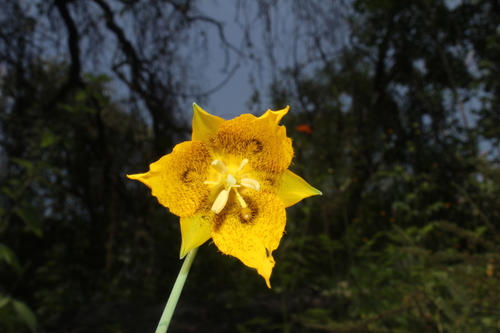
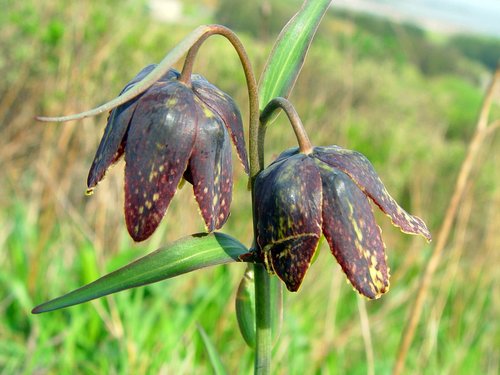
Fritillaria affinis (Schult. & Schult.f.) Sealy grows from a bulb that resembles a small mass of rice grains. Its stems reach 10–120 centimetres (4–47 inches) in height. The nodding flowers form in spring, measure 1–4 cm (1⁄2–1+1⁄2 in), and vary in color: they can be yellowish or greenish brown with heavy yellow mottling, purplish black with little mottling, or yellow-green mottled with purple. Its leaves are arranged in whorls. There are two recognized varieties of this species. Fritillaria affinis var. affinis is the more common and widespread variant, found across the entire range of the species. It is distinguished by a strong mottling pattern, and its bulb holds 2 to 20 small scales. Fritillaria affinis var. tristulis is far less widespread, occurring only in Marin County on the north coast of California. It has a much more subtle mottling pattern, is generally darker overall, and its bulb contains 60 to 100 small scales. This species can be found from California (where it occurs in the Klamath Ranges, north coast ranges, Cascade Ranges, north Sierra Nevada foothills, and the San Francisco Bay Area) north to British Columbia, Oregon, Washington, Montana and Idaho. It grows in oak or pine scrub, open woods, and thickets near the coast. It prefers low to mid-elevation sites, shade or part shade, dry summer dormancy, and good drainage. The roots or bulbs of Fritillaria affinis can be eaten raw or cooked. Historically, Salish Native American peoples including the Squamish, Sechelt, Halq'emeylem and Straits Salish ate the bulbs of this plant steamed.