About Fritillaria acmopetala Boiss.
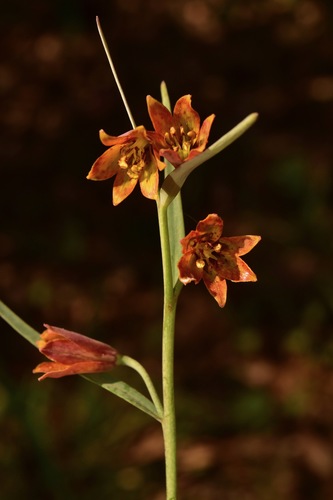
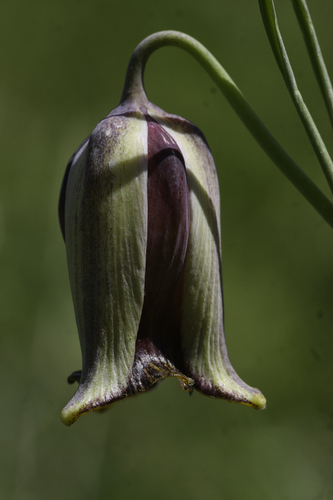
Fritillaria acmopetala Boiss. is a bulbous perennial plant that grows an erect stem between 30 and 70 cm (12 to 28 inches) tall. Its long, straight, very narrow leaves grow in whorls on the lower part of the stem, and in pairs near the top of the stem. Each node on the stem bears one or more nodding flowers. Each flower has six tepals, each 3 cm long. Outer tepals are yellowish-green with darker patches and red veins; inner tepals are purplish brown at the top and bottom. The interior of all tepals is yellow. The bell-shaped flowers flare out sharply at their opening. There are two recognized subspecies: Fritillaria acmopetala ssp. acmopetala and Fritillaria acmopetala ssp. wendelboi. The wendelboi subspecies has broader leaves, and is restricted to Southern Turkey. This species is distributed across northern Cyprus, southern Turkey (from Lycia to Cilicia), the Nur Dağları of Hatay Province, Lebanon, Israel and Palestine. It grows in maquis, open woodland, and cornfields. The subspecies Fritillaria acmopetala ssp. wendelboi grows in cedar woodland at higher altitudes. On Cyprus, it grows in cornfields and under olive trees in the Girne district, in the villages of Karaman and Edremit. This plant was first introduced into cultivation in 1874. Like most fritillaries, it requires well-draining, fertile soil. Bulbs should be planted 10 cm (3.9 in) deep. In Britain, it is fully hardy, and flowers in early April. It has been awarded the Royal Horticultural Society's Award of Garden Merit. It can be eaten by the predatory red lily beetle (Lilioceris lilii), and may develop lily disease, an infection caused by the plant pathogenic fungus Botrytis elliptica.