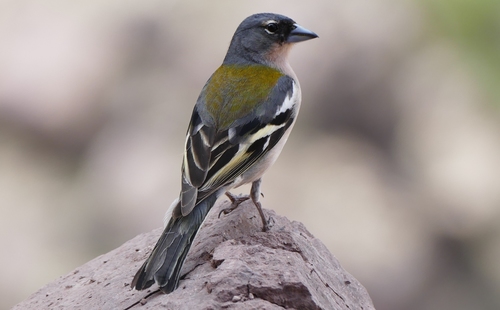
About Fringilla spodiogenys Bonaparte, 1841
Field identification: The African chaffinch, formally Fringilla spodiogenys Bonaparte, 1841, is a medium-to-large finch that measures 13.8–18.5 cm (5.4–7.3 in) in length and weighs 21–24 g (0.74–0.85 oz). Males and females have distinct plumage characteristics. Adult males have a blue-grey head with a small black patch on the forehead above the bill, and a moss-green mantle. This mantle colour is very different from the reddish-brown mantle of the Eurasian chaffinch, and the African chaffinch also lacks the reddish cheeks that the Eurasian chaffinch has. The adult male's wings are black with two bold white stripes, plus white edges to the tertials and secondaries; its tail is blue-grey with white sides. The male's throat, breast, and upper belly are pale pinkish, fading to white on the lower belly and undertail. Its legs are dark pinkish-brown, and the bill is silvery blue-grey with a black tip. In winter, male plumage becomes duller, with the head turning more grey-brown and the mantle turning more brownish-green. Females and juveniles are overall greyish brown, with dark brown and white stripes on the wings, a lighter brown and white underbelly, a dull greyish brown head, and brown legs. Eurasian chaffinches occur as non-breeding winter visitors to northwest Africa, where they may be found alongside African chaffinches. Distribution and habitat: The African chaffinch occurs across a range from southern Morocco to northwestern Libya, with an additional isolated population in northeastern Libya. It is also found on the Italian islands of Lampedusa and Pantelleria, which lie off the Tunisian coast in the Strait of Sicily. This species is non-migratory, and usually only disperses over short distances. African chaffinches typically inhabit lowland deciduous forests and mixed woodland containing maple (Acer), hornbeam (Carpinus), oak (Quercus), and pine (Pinus), as well as forest edges and clearings. In the Moroccan High Atlas, the species lives in Juniperus thurifera woodland. During the non-breeding season, it expands into similar habitats and open agricultural areas, including weedy fields, stubble fields, olive groves, palm groves, and desert oases. There are a small number of accepted vagrant records of African chaffinches in northern Europe: one in Sweden on 5 April 1998, one in Sweden on 5 May 2003, one in Norway on 13 April 1998, one in Norway on 12 April 2002, one in the Netherlands from 4–5 April 2003, and one in France on 19 April 2003. Two further reports, one from England in 1994–1995 and one from the Netherlands in 1999, have not been accepted by the relevant national bird records committees.